
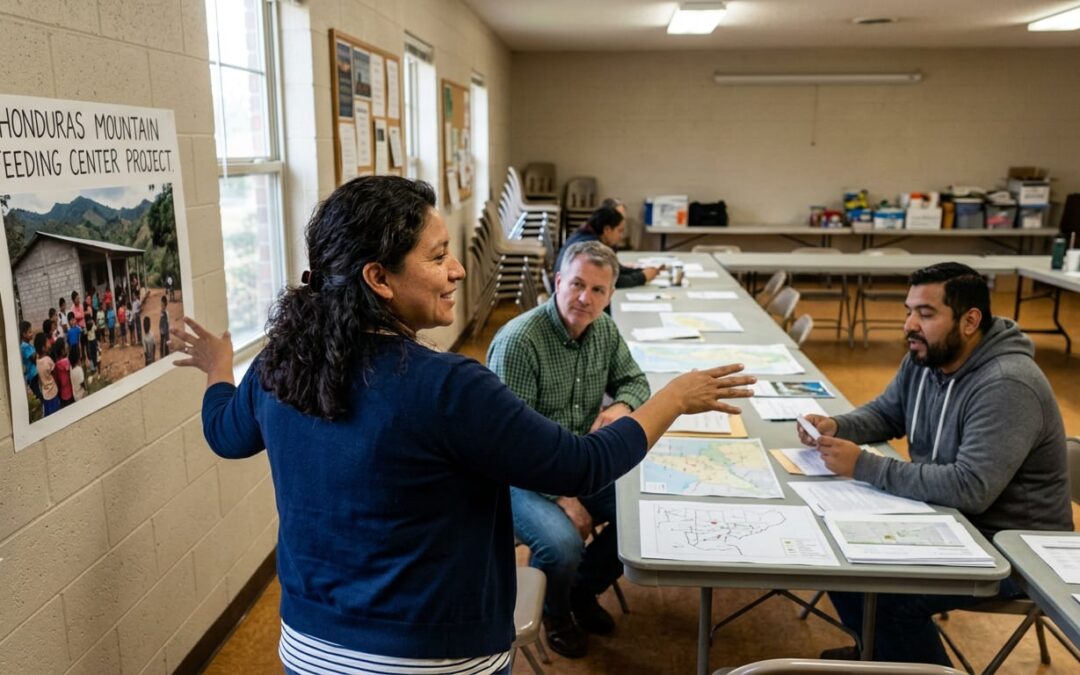
Organizing a fundraiser for a humanitarian nonprofit works best when you anchor the entire event to one specific, active project – so every participant knows exactly what they are funding. That single focus is what separates a forgettable collection plate from a fundraiser that builds lasting community investment. Impact Others Inc. connects community groups, church congregations, and business networks with active humanitarian projects in countries like Honduras, India, Ghana, and Colombia, giving organizers a real, tangible cause to rally around.
What Makes a Community Fundraiser Actually Work?
The most effective community fundraisers center on a single, specific project so participants understand exactly what they are funding. When people can picture a feeding center in Honduras or a water cistern in the mountains, their giving becomes personal – not abstract.
Here are the steps that move a fundraiser from idea to impact:
- Choose one project to champion. A fundraiser tied to "clean water for a village in Honduras" raises more engagement than one for "general humanitarian aid." Specificity creates connection. Contact Impact Others Inc. at info@impactothers.com or 2196780669 to learn which active projects are currently accepting community support.
- Set a concrete funding goal. Work with the organization to understand what a project needs and frame your goal around that. A number gives participants something to chase together.
- Recruit a small planning team. Assign one person to logistics, one to communications, and one to donor follow-up. Three focused people outperform a committee of ten with no clear roles.
- Pick a format that fits your group. Dinner galas, pledge drives, bake sales, peer-to-peer campaigns, and church offering appeals all work – the right format is the one your community will actually show up for.
- Tell the story, not the statistics. Share what the project does in human terms. Project information and updates can be shared with participants to build trust and momentum throughout the campaign.
- Create a giving deadline. Open-ended fundraisers stall. A clear close date – tied to a meal, a service, or a calendar milestone – drives action.
- Follow up with every participant. A short message after the event, sharing what was raised and where it goes, turns one-time donors into long-term partners.
How Do You Connect a Local Fundraiser to a Real International Project?
The bridge between a church fellowship hall in Indiana and a feeding center in Honduras is a funding and stewardship organization that maintains relationships with vetted local partners on the ground. Impact Others Inc. raises funds and sends them directly to those partners, who manage the projects and their own operations. The organization receives regular project updates and documentation, which organizers can then share with their community.
One partner who experienced this firsthand put it this way: "One of the things we love about Impact Others is that you get to participate firsthand. You can be as involved as you want, but the great thing is you actually get to see the incredible work being done around the world." That quote came from a real estate development couple in Denver who built community giving into their business model after connecting with Impact Others Inc. – proof that a structured giving partnership can scale from a personal commitment to a community movement.
At Impact Others Inc., every dollar donated to a project goes directly to that project, so your generosity reaches the people who need it most. That means when your church group raises funds for a feeding program, the full amount moves toward food – not overhead.
What Are the Legal and Compliance Basics Organizers Should Know?
Fundraising compliance is a real responsibility, and community organizers often underestimate it. The National Council of Nonprofits notes that 40 states require charitable nonprofits and paid fundraising counsel to register before soliciting donations from residents of that state. If your community group is raising funds on behalf of a nonprofit, understanding that registration landscape matters.
A few practical points:
- Clarify who is the soliciting entity. Is your church group raising money and remitting it to Impact Others Inc., or are participants donating directly? The answer affects which compliance obligations apply.
- Be transparent about how funds are used. Never imply donations will be used for a purpose other than the one you describe. Tie every ask to the specific project.
- Avoid professional solicitors without due diligence. If you hire someone to help solicit, the Federal Trade Commission requires that solicitors identify the charity and the purpose of the call promptly, and may only call between 8 a.m. and 9 p.m.
- Consult a qualified advisor for tax questions. Impact Others Inc. does not provide legal or tax advice. Any questions about deductibility should go to a licensed tax professional.
The simplest path for most community groups is to direct participants to donate to Impact Others Inc. directly, rather than pooling funds through an unregistered group – a step worth discussing when you reach out to align your fundraiser with an active project.
How Do You Keep Participants Engaged After the Fundraiser?
The fundraiser is a starting point, not a finish line. The communities that generate the most sustained impact are the ones that stay connected to the project they funded.
Impact Others Inc. makes that connection tangible. Donors and partner groups have traveled to project sites in Honduras and elsewhere to see the work firsthand. One donor described crossing four rivers into the mountains of Honduras to visit water cisterns and a feeding center: "I feel like it's very difficult to have a complete understanding until you physically put your hands on it. The impact that's been made here is just outstanding." That kind of direct witness transforms a fundraiser participant into a long-term advocate.
For groups that cannot travel, project photos, documented updates, and the knowledge that every dollar reached the project are the threads that keep community giving alive between campaigns. Organizers who share those updates – even a single photo and a sentence about what was accomplished – consistently see stronger participation in subsequent fundraisers.
Building a recurring giving culture inside your community is the goal. A one-time event raises funds; a sustained partnership changes lives.
Reaching out to Impact Others Inc. at info@impactothers.com or 2196780669 is the right first step to align a community fundraiser with an active project. The team can walk you through which projects are currently open, what information you can share with your group, and how to structure the giving so every dollar reaches the field. If you want to discuss what a longer-term giving partnership looks like, the Impact Others Partner Program is worth a conversation.
Impact Others Inc. is located at 5885 Cumming Hwy, Ste 108347, Sugar Hill, GA 30518.
FAQ
Who should be the first contact when organizing a fundraiser tied to Impact Others Inc.?
Reach out directly to Impact Others Inc. at info@impactothers.com or by calling 2196780669. The team can match your group with an active project, provide shareable project information, and help you set a funding goal that reflects real, current needs in the field.
Which fundraiser format works best for a church group or community organization?
The format that works best is the one your community will genuinely show up for. Dinner events, pledge drives, peer-to-peer campaigns, and church offering appeals have all been used effectively. The more important variable is tying the format to a single, specific project – a feeding center, a water cistern, an orphanage – so every participant understands what their contribution supports.
Where does the money go when a community group raises funds for a humanitarian project?
When funds are raised in support of an Impact Others Inc. project, the full project donation reaches the project. Impact Others Inc. sends funds directly to vetted local partners who manage the work on the ground. The organization receives project updates and documentation, which can be shared with your community to show the real-world result of their generosity.
How do compliance and registration requirements affect community fundraisers?
Compliance depends on how your group structures the fundraiser. The National Council of Nonprofits notes that 40 states require charitable nonprofits and paid fundraising counsel to register before soliciting residents. For most community groups, the simplest path is directing participants to donate to Impact Others Inc. directly, rather than collecting and remitting pooled funds. Always consult a qualified legal or tax advisor for guidance specific to your situation.