
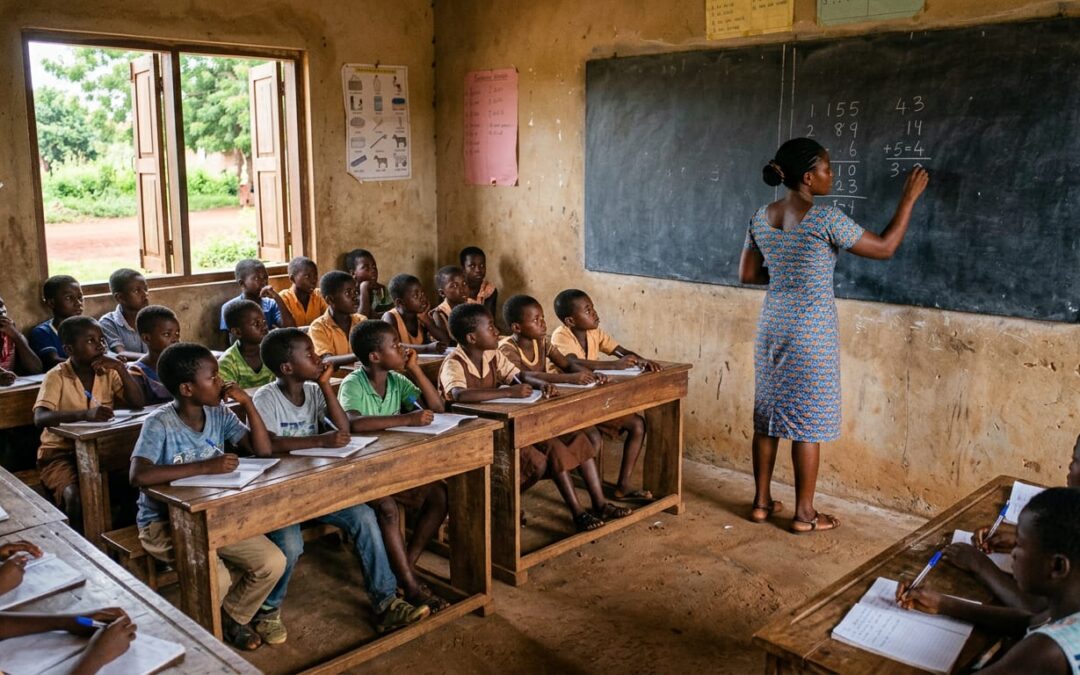
Education helps children in underserved communities by giving them the tools to move from receiving support to actively contributing to the people around them. When a child learns to read, reason, and solve problems, that capacity does not stay contained – it spreads into households, neighborhoods, and eventually the broader community. Impact Others Inc. has seen this pattern play out across its partner network in countries including Ghana, Nigeria, and Honduras, where education sits alongside clean water, food, and safety as one of the interconnected needs that determines whether a child can actually show up and learn.
What Does Education Actually Change for a Child in an Underserved Community?
Education changes a child's relationship to their future and to the people around them. Without it, a child remains dependent on outside support indefinitely. With it, they develop the skills to contribute – to earn, to teach, to lead, and to solve problems that affect others.
The shift is not abstract. A child who can read can help a younger sibling learn. A child who understands basic math can assist a parent running a small business. A child who stays in school long enough to finish secondary education enters adulthood with options that were not available to the generation before them.
The scale of the gap makes this concrete: Children International puts the share of 10-year-olds in developing nations who cannot read or understand a simple story at 60 percent. That figure describes not just individual limitation but a community-wide ceiling on what is possible. When education funding reaches children who would otherwise fall into that statistic, it raises that ceiling for everyone around them.
The gender dimension matters here too. UNICEF notes that girls who receive an education are less likely to marry young and more likely to lead healthy, productive lives – a finding that speaks directly to how one child's education reshapes the trajectory of an entire family.
Why Can't Education Work on Its Own?
Education cannot function in isolation – it depends on the conditions that make attendance possible in the first place.
A child who is hungry cannot concentrate. A child without clean water nearby spends hours of the day collecting it instead of sitting in a classroom. A child living without safety or stable shelter has no reliable path to school. This is why funding education alongside food, water, and protection is not a philosophical choice – it is a practical one.
Impact Others Inc. funds these interconnected needs through trusted local partners who understand which combination of support a specific community requires. In Ghana, a medical outreach clinic delivered medical and vision care to more than 2,100 people, with donated eyeglasses restoring vision for many patients. Vision care and education are inseparable: a child who cannot see the board cannot learn from it. That kind of connected thinking – treating the whole child and the whole community – is what makes educational investment stick rather than stall.
When food, water, health, and safety are addressed together, the path to the classroom opens. Education then does what it cannot do alone: it compounds.
How Does an Educated Child Strengthen the Community Around Them?
The clearest way to understand education's community impact is to follow what happens after a child finishes school.
An educated young person who stays in their community brings skills back to it. They are more likely to start or sustain a small business, which creates employment for neighbors. They are more likely to mentor younger children, extending the reach of the education they received. They are more likely to engage in community decisions with the kind of informed perspective that improves outcomes for everyone.
In Nigeria in 2025, seven widows received financial assistance through Impact Others Inc.'s local partner network to launch small businesses – creating pathways to long-term independence. That model of economic contribution mirrors what education makes possible at scale: individuals who were once in need of support becoming people who generate opportunity for others.
The ripple effect donors often describe when they give to children's causes is not a metaphor. It is a documented pattern. One generation of educated children produces the next generation of teachers, health workers, and community leaders. The donor who funds a child's education today is not just helping that child – they are investing in the community that child will help lead.
What Does It Look Like When a Donor Sees This Work in Person?
Understanding education's impact from a distance is one thing. Witnessing it changes a person.
Impact Others Inc. takes donors to visit the projects their giving funds, so they see the work in person. A donor who has crossed rivers in Honduras to reach a mountain community, sat with children at a feeding center, and watched the connection between food, safety, and learning does not describe the experience in abstract terms.
One donor who made that trip put it plainly: "I feel like it's very difficult to have a complete understanding until you physically put your hands on it. The impact that's been made here is just outstanding… I think I spent my first night crying. I woke up the next morning and cried after hearing John's stories, getting to meet kids at the first feeding center, experiencing things firsthand."
That firsthand encounter – seeing children who have access to food, water, and education rather than being denied all three – is what turns a donor's generosity into something they feel connected to for the rest of their lives. It is also what makes the giving purposeful rather than transactional.
What Determines Whether Educational Funding Actually Reaches Children?
Whether educational funding produces lasting change depends on two things: the quality of the local partner managing it, and whether the surrounding needs are addressed at the same time.
Impact Others Inc. sends donations directly to trusted local partners who manage educational and humanitarian projects on the ground. Those partners are accountable to Impact Others Inc. and provide progress documentation, which means the work is tracked and verified – not assumed. Donors who want to go further than documentation can visit project sites in person, which is the clearest form of accountability available.
The cost of funding education through this model is shaped by what the local partner identifies as necessary: classroom materials, teacher support, school feeding programs, or the health and water access that makes attendance possible. What drives the difference in impact between one community and another is rarely the funding amount alone – it is whether the whole picture is addressed, and whether the partner on the ground has the relationships and knowledge to deliver it.
For donors considering where to direct their giving, the question worth asking is not just "does this organization fund education?" but "does this organization fund the conditions that make education possible?" Those are different questions with different answers.
Giving to education is giving to a community's future, not just a child's present. When a child who once had no access to learning becomes a young adult who teaches, employs, or leads, the donor who made that possible has contributed something that compounds long after the initial gift. Impact Others Projects shows which specific communities are being reached right now and what educational and humanitarian work your giving could support.
To learn more or connect with the team directly, reach Impact Others Inc. at info@impactothers.com, by phone at 2196780669, or by mail at 5885 Cumming Hwy Ste 108347, Sugar Hill, GA 30518.
FAQ
Who benefits most from education funding in underserved communities right now?
Children who lack access to food, clean water, and health care alongside education benefit most when those needs are addressed together. Girls face a particularly steep disadvantage – UNICEF USA found in 2022 that almost one in four girls between the ages of 15 and 19 is neither working nor in school or vocational training, compared to one in 10 boys. Funding that reaches girls through trusted local partners addresses one of the highest-impact gaps in community development.
Which humanitarian needs have to be met before education can take hold?
Clean water, food security, basic health care, and physical safety are the conditions that make school attendance possible. A child who is sick, hungry, or spending hours collecting water cannot benefit from a classroom. Impact Others Inc. funds these interconnected needs through local partners in countries including Ghana, Nigeria, and Honduras, because education only compounds when the surrounding conditions support it.
Where does the money go when someone donates to education through a humanitarian organization?
When donors give to Impact Others Inc. for educational or humanitarian projects, those funds go directly to trusted local partners who manage the work on the ground. Impact Others Inc. raises and stewards the funds, maintains independent bookkeeping, and receives progress documentation from partners. Donors can also visit project sites in person – which is the most direct way to see that the work is real and the children are being reached.
How does a child's education eventually benefit the adults around them in the same community?
An educated child who stays in their community brings skills back to it – through small business creation, mentorship of younger children, and informed participation in community decisions. This is the compounding effect donors often describe: one generation of children with access to education becomes the next generation of teachers, health workers, and local leaders. In Nigeria in 2025, Impact Others Inc.'s local partners supported seven widows in launching small businesses – a direct example of how individual capacity, built over time, strengthens the community around it.