
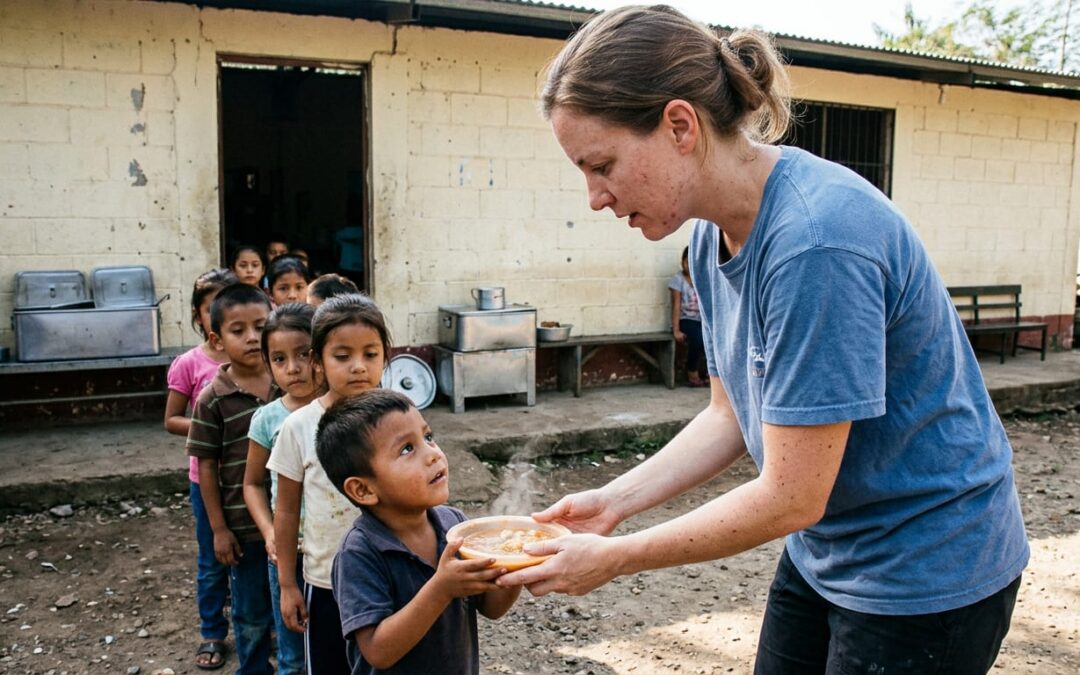
For most people who want to create lasting humanitarian impact, donating money to trusted local partners is more effective than short-term volunteering. Financial support allows communities to plan, staff, and sustain programs over time – something a one-week visit simply cannot do. That said, the right answer depends on what "effective" means in your specific situation, and both approaches have a genuine role when applied honestly.
Impact Others Inc. connects everyday supporters with humanitarian work around the world, giving each gift a clear purpose and a real outcome to stand behind. The organization has tracked this dynamic across its partner communities in Honduras, Ghana, Colombia, and beyond: the work that endures is the work that is consistently funded, not the work that depends on rotating visitors.
What does "effective" actually mean in humanitarian work?
Effectiveness in humanitarian aid is measured by whether a community's needs are met consistently – not whether a supporter felt the experience was meaningful. Those two things can overlap, but they are not the same.
A feeding center that serves children every day requires food, staff, and logistics every day. A water cistern needs maintenance funding after it is built. An orphanage needs caregivers who show up year after year. These outcomes are driven by reliable resources, not by the presence of outside visitors on any given week.
When the question is donating vs volunteering effectiveness, the honest answer is that financial support scales in ways that personal time does not. A donor giving monthly provides a foundation that a local partner can build a real program around – hiring staff, ordering supplies, planning ahead. A short-term volunteer provides presence, which has value, but presence ends when the trip does.
When is donating money more effective than volunteering?
Donating money tends to create more sustained impact than volunteering under these specific conditions:
- When local partners already exist and are trusted. Communities with established local leadership do not need outside people to manage the work – they need resources to do it. Sending funds directly to those partners means the work continues long after any individual visit ends.
- When the need is ongoing, not one-time. Hunger, water access, and orphan care are not problems solved in a week. Recurring financial support allows trusted local partners to plan, staff, and sustain projects over time in ways that episodic volunteering cannot.
- When the volunteer lacks specialized skills. General labor from outside visitors can sometimes displace paid local workers, reducing the economic benefit to the community. Skilled volunteers – doctors, engineers, educators – add something local partners cannot easily replicate. Unskilled short-term visits often add less than the cost of organizing them.
- When the donor cannot travel. Proximity is not a prerequisite for impact.
- When consistency matters more than presence. Donors who give monthly provide a foundation of predictable resources that local partners can build programs around. That predictability is itself a form of impact.
A 2023 study published in Academy of Management Proceedings found that volunteering and donation behavior are connected – people who volunteer often give more financially afterward – which suggests the two are not strictly competing choices. But for communities that need sustained support, the financial contribution is what keeps programs running.
Does volunteering have any advantages over donating?
Yes, and this comparison is worth being honest about. Volunteering offers things that a check cannot: direct relationships, cultural exchange, and a personal witness to the conditions on the ground. For the volunteer, it can be a transformative experience. For the community, skilled volunteers filling genuine gaps – medical professionals, teachers, tradespeople – can add real value that funding alone does not replace.
There is also evidence that time spent volunteering can lead to greater financial giving later, as Stanford Graduate School of Business summarized from Journal of Consumer Research research. The two forms of generosity often strengthen each other rather than compete.
One partner who traveled to Guadalajara with Impact Others Inc. described the experience plainly: "One of the things we love about Impact Others is that you get to participate firsthand. You can be as involved as you want, but the great thing is you actually get to see the incredible work being done around the world."
That firsthand witness matters – not because the visit itself feeds children, but because it builds the conviction that sustains long-term giving. The trip deepens the commitment; the commitment funds the work.
For the communities themselves, though, what sustains their programs is not visits. It is the consistent financial support that follows.
What makes financial giving through local partners more effective in 2026?
The model of funding trusted local partners – rather than deploying outside volunteers – has become increasingly recognized as the more sustainable approach to international humanitarian work. Local partners who live and work in the communities they serve are better positioned to deliver consistent aid than short-term outside volunteers. They understand the culture, the logistics, and the people. They are there every day.
Impact Others Inc. raises funds and sends project-related donations directly to local partners – keeping administrative costs low so more of each gift reaches the work. Rather than managing construction or running field operations directly, the organization connects everyday supporters with humanitarian work around the world, giving each gift a clear purpose and a real outcome to stand behind.
For donors who want to verify that the work is real, Impact Others takes supporters on site visits to partner locations, where they can see feeding centers, water projects, orphanages, and small business programs firsthand. Mindy Tibbs, an Impact Others partner for about four years, put it this way: "When I think about Impact Others, I picture my own children in a third-world country. If a business owner had the answer to what my child needed – whether it was clean water from a well, a sewing center, food, an orphanage, housing, or any of the other life-changing resources – would they give? That's why I partner with Impact Others."
That framing – imagining the people being served as people you know – is what turns a financial gift from a transaction into a purpose.
If you are weighing how to verify international nonprofit legitimacy before committing to a giving relationship, the same principle applies: the organizations worth trusting are the ones whose local partners are doing the work every day, not only when visitors are present.
Which approach is right for you?
The choice between donating and volunteering is not a ranking of generosity – it is a question of fit.
| Situation | More effective approach |
|---|---|
| You cannot travel or commit time | Recurring financial donation |
| You have specialized skills (medical, trade, education) | Volunteering, ideally paired with giving |
| The need is ongoing (food, water, orphan care) | Consistent financial support |
| You want to build long-term connection | Site visit paired with monthly giving |
| You want your support to outlast your presence | Financial donation to local partners |
The key takeaway: for most humanitarian needs, consistent funding outlasts any single visit – and the two approaches work best when they strengthen each other rather than substitute for one another.
If you are ready to make your generosity count beyond a single trip, consider learning more about how to become a monthly supporter through Impact Others Inc. – it is one of the most direct ways to give local partners the predictable foundation they need to plan and sustain real programs.
To connect or ask questions, reach the Impact Others Inc. team at info@impactothers.com, by phone at 2196780669, or by mail at 5885 Cumming Hwy Ste 108347, Sugar Hill, GA 30518. Every conversation starts with the same question: where do you want your generosity to go?