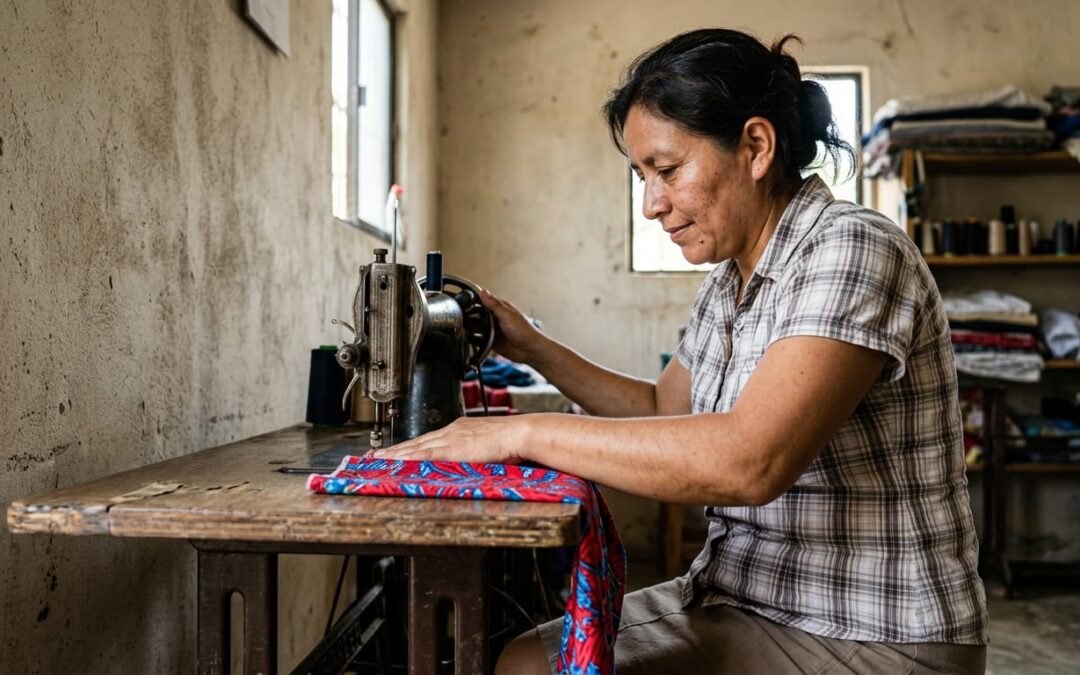
Business opportunity programs help people become self-sufficient by giving them the skills, tools, and starting resources to generate their own income – reducing their dependence on outside aid over time. The core idea is straightforward: when someone can earn a living, they can meet their own needs, support their family, and contribute to their community. Impact Others Inc. funds exactly this kind of work, channeling donor contributions to local partners who design and run small business development programs in the communities they know best.
What do business opportunity programs actually do for people?
Business opportunity programs provide more than a one-time resource. They build capacity – the kind that stays with a person long after a program ends. The specific components vary by community and local partner, but most programs combine several of the following elements:
- Skills training – Participants learn a trade, craft, or service they can offer in their local market, whether that is sewing, food preparation, agricultural techniques, or small-scale manufacturing.
- Access to tools or startup materials – Many people have the drive to work but lack the basic equipment to begin. Programs often supply a sewing machine, farming inputs, or a small inventory to get started.
- Business fundamentals – Understanding how to price a product, manage simple records, and serve customers consistently is what separates a one-time sale from a sustainable enterprise. Research from J-PAL found that traditional business skills training for microentrepreneurs increased sales by an average of 5.6% and profits by an average of 12.1%.
- Community connection – Local partners embed participants in networks of other small business owners, which creates informal accountability and shared problem-solving.
- Ongoing support – The most effective programs do not end at graduation. Follow-up from local mentors helps participants navigate early setbacks and build confidence.
Each of these elements targets a different barrier. Removing only one – say, providing tools without training – rarely produces lasting results. The combination is what moves someone from receiving aid to running something of their own.
How does self-sufficiency through a small business compare to ongoing aid?
Both ongoing aid and business development serve real needs, and the two are not in competition. Emergency food assistance, clean water access, and orphanage care address immediate, urgent needs that cannot wait. Business opportunity programs address a different question: what happens after the immediate crisis is stabilized?
| Approach | Primary purpose | Time horizon | Who it serves best |
|---|---|---|---|
| Emergency aid (food, water) | Survival and stabilization | Immediate | People in acute need |
| Ongoing support programs | Sustained wellbeing | Medium-term | Families in recovery |
| Business opportunity programs | Income generation and independence | Long-term | Adults with capacity to work |
These approaches work best together, not as substitutes. A family that receives food assistance while a parent completes a skills training program is on a more stable path than one receiving only one or the other.
What that combination looks like in practice is something Impact Others Inc. partners have experienced directly. One group traveled to Brazil through Project Dakota, visiting children and seniors in their communities. A participant from that group wrote: "Thank you for giving us an experience we will never forget. The smiles and joy of the children, and the opportunity to bring a little comfort and kindness to the seniors, touched our hearts deeply! We came to Brazil hoping to make a difference, but we feel like we received so much more than we gave. This experience has reminded us how powerful kindness, compassion and simply showing up for others can be. Thank you for allowing us to be part of something so meaningful. We're leaving with beautiful memories and a desire to continue making a difference. We hope this is just the beginning of many more journeys together." That response – the sense that showing up consistently, across both immediate care and longer-term development, changes people on both sides of the work – reflects what integrated programs make possible.
The Aspen Institute tracked poor microentrepreneurs over five years and found that 72% increased their household income by an average of $8,484 – a meaningful, measurable shift in family stability. That kind of outcome is why donors who give to business opportunity projects through Impact Others Inc. often describe it as investing in long-term change rather than short-term relief alone.
What makes a business opportunity program work right now, in 2026?
The most effective programs today share a few characteristics that distinguish them from older models of economic development.
Local design matters more than imported models. Programs built by community members who understand the local economy – what goods people buy, what services are missing, what seasonal patterns affect income – outperform programs designed externally and transplanted in. This is precisely why Impact Others Inc. funds local partners rather than managing programs from a distance. The partners live in these communities and carry the knowledge that no outside organization can replicate.
Survival is not guaranteed, and honesty about that matters. The Aspen Institute puts the five-year survival rate of microbusinesses at 49%. That figure is not discouraging – it is realistic. It means that good programs build resilience and adaptability into their training, not just optimism. Participants who understand that businesses face setbacks are better prepared to push through them.
Dignity is not optional. The most durable programs treat participants as capable people who need access and support, not as recipients of charity. This belief – that people have real capacity and that the right support can help them build something lasting – shapes how Impact Others Inc. approaches every business development project it funds.
What does it actually cost to fund a business opportunity program?
The cost of funding a business opportunity program depends on several factors: the type of training involved, the materials or equipment required, the size of the cohort, and the local cost of living in the country where the program runs. A sewing center in one country carries different costs than an agricultural training program in another.
What donors to Impact Others Inc. can know with certainty is that 100% of project-related donations go directly to the project. Administrative expenses are kept deliberately low, which means more of every dollar reaches the people the program is designed to serve. That is a meaningful distinction when comparing how different organizations steward donor funds.
The best question to ask before giving is not "how much does it cost in total?" but "how much of what I give actually reaches the program?" For Impact Others Inc., the answer to that second question is straightforward.
Why does giving to self-sufficiency programs matter to donors?
Donors who give to business opportunity projects often describe a specific kind of satisfaction: they are not just meeting a need today, they are helping someone build something that outlasts the donation. That distinction matters to people who want their generosity to create lasting change rather than temporary relief alone.
When you give through Impact Others Inc., you can see exactly where your support goes – because we take donors to the places your giving changes. That firsthand connection – standing in a community, meeting the people whose lives are being changed – is what turns a transaction into a partnership.
For donors who want to go deeper, the Impact Others Inc. Business Opportunity Projects page gives a closer look at the specific programs currently being funded and the communities they serve.
If you want to learn more about how your giving can support self-sufficiency programs around the world, reach out to Impact Others Inc. directly. Call 2196780669, email info@impactothers.com, or write to 5885 Cumming Hwy Ste 108347, Sugar Hill, GA 30518. Every dollar you give to a project goes to that project – and you are always welcome to come and see it for yourself.
FAQ
Who benefits most from business opportunity programs?
Adults who have survived an immediate crisis – whether poverty, displacement, or food insecurity – and have the capacity and desire to build a livelihood benefit most from business opportunity programs. These programs are designed for people who are ready to work but lack the skills, tools, or starting resources to do so independently. They are not a substitute for emergency aid; they are what comes next.
Which types of businesses do these programs typically help people start?
The most common small enterprises supported through these programs include sewing and textile work, food production and preparation, small-scale agriculture, and local trade or retail. The specific type depends on what the local economy supports and what the community's local partners identify as viable. Programs grounded in local knowledge tend to produce businesses with better staying power than those built around externally imposed models.
How do donors know their money is actually reaching the program?
Impact Others Inc. sends 100% of project-related donations directly to the project, keeping administrative expenses low. Beyond the financial structure, Impact Others Inc. takes donors on trips to project locations so they can witness the work firsthand. That direct access – visiting a sewing center, meeting participants, seeing the community – is the most concrete form of accountability a donor can have.
Where does Impact Others Inc. currently fund business opportunity programs?
Impact Others Inc. funds humanitarian work through local partners in multiple countries, including Honduras, Nigeria, Ghana, India, Egypt, Colombia, and Thailand, as well as foster care work in the United States. Business opportunity programs are one of several program types funded across these locations, alongside clean water, food, orphanage support, and education initiatives.