
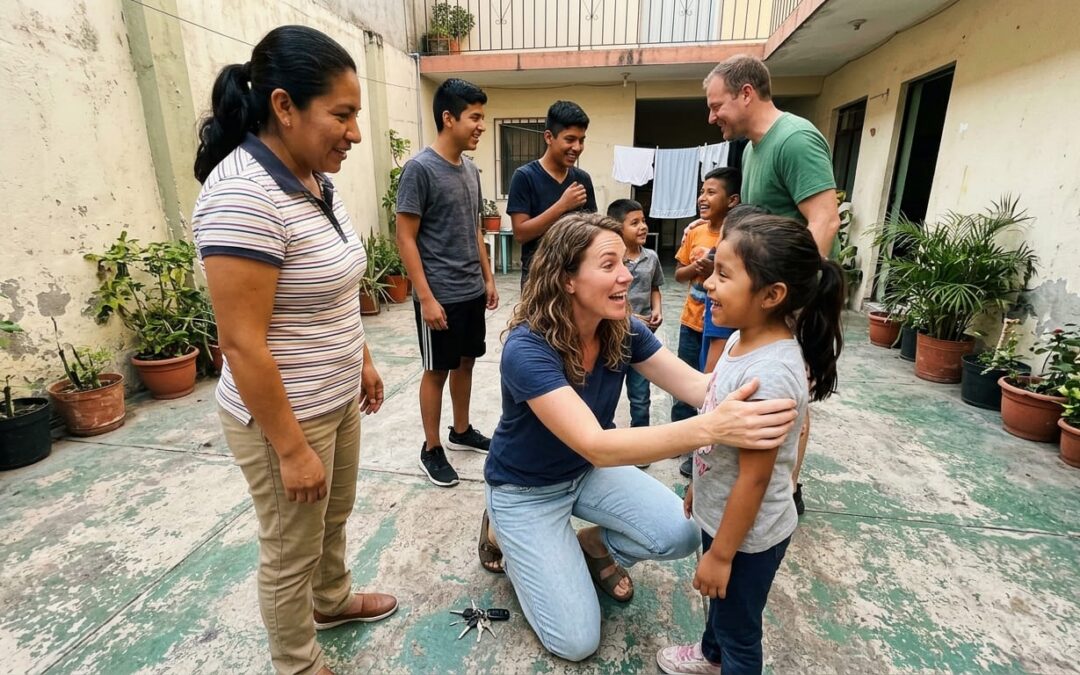
A donor trip to a humanitarian project site is exactly what it sounds like: you travel to the community where the work is happening, meet the local partners running it, and see the project with your own eyes. No intermediary summary, no secondhand account – just the real place and the real people. Impact Others Inc. has organized these trips and tracked what donors take away from them, and that firsthand record shapes everything below.
The trips are not staged presentations. They follow the actual work – water cisterns in the mountains of Honduras, feeding centers in communities where food is scarce, orphanages in Guadalajara. What donors consistently say afterward is that no written update could have prepared them for what they witnessed in person.
What Actually Happens During a Donor Trip?
A donor trip moves through several distinct phases, from arrival to community time to reflection. Here is what a typical visit includes:
- Travel to the project location. Some sites are straightforward to reach; others require crossing rivers or trekking into mountain terrain. One donor who visited a water cistern project in the hills of Honduras described crossing four rivers to reach the community – an experience that itself communicated the isolation these communities face.
- Meeting the local partner team. Impact Others works through trusted local partners who manage the project day-to-day. The trip gives donors direct access to those people – the ones who know the community, speak the language, and have built the relationships that make the work possible.
- Observing the project in progress. Donors see the physical infrastructure, the feeding centers, the orphanage programs, or whatever the specific project involves. This is where the connection between a grant and a visible result becomes undeniable.
- Spending time with community members. This is often what donors remember most. Meeting the children, the families, and the individuals the project serves puts a human face on what philanthropy produces.
- Sharing the experience with other donors. Most trips include a small group of partners and supporters, which creates space for honest conversation about what giving at this level actually means.
Donor Visit.pdf (2023) recommends that a visit team include a project staff member directly handling the work, a communications person for photography and documentation, and someone from the fundraising side – a structure that keeps the visit grounded in reality rather than theater.
What Do Donors Say When They Come Back?
The firsthand accounts from people who have taken these trips are the clearest evidence of what they produce.
One donor couple – real estate developers from Denver – joined a trip to Guadalajara after learning about Impact Others Inc. through a professional network. Their words afterward: "One of the things we love about Impact Others is that you get to participate firsthand. You can be as involved as you want, but the great thing is you actually get to see the incredible work being done around the world. For us, it was a natural fit to become an Impact Others partner."
Another donor, Barbara, traveled to Guadalajara and spent time running a master class with young adults at an orphanage there. She described it this way: "We just finished an amazing day. We had a master class with the young adults in the orphanage here, and it was truly impactful. We decided to become Impact Others partners after our 17-year-old had already done a one-week mission trip. We looked at each other and said, 'Oh my God, we really need to get heavily involved in being a partner and being part of this greater thing.'"
A donor named Zach Whitley traveled into the mountains of Honduras to visit a water cisterns project and a feeding center. His account: "The overall experience has just been incredible… John and his people were fantastic and I can't say enough about how this has affected me, changed me. I think I spent my first night crying. I woke up the next morning and cried after hearing John's stories, getting to meet kids at the first feeding center, experiencing things firsthand. The work that they've done here is incredible from the water cisterns project that we visited and got to see to the amount of people that have been fed and continue to be fed on a daily basis."
These are not polished endorsements. They are what happens when someone who gives strategically finally sees where the money went.
Why Does Seeing It in Person Matter for DAF Holders and Advisors?
For donors who direct grants through a Donor-Advised Fund, the accountability question is real. DAF holders often wonder whether their grant reached its intended destination and whether the work is genuinely underway. A site visit answers that question in a way that no document can replicate.
Seeing a project in person is one of the most direct ways a donor can verify that funds reached their intended destination and that work is underway. That matters especially for financial advisors who recommend grant recipients to clients – firsthand knowledge of a project gives an advisor something concrete to stand behind.
These trips are part of how Impact Others Inc. shows that its stewardship is real and that the local partners it works with are doing what they said they would do. The invitation to visit is not incidental to that work; it is central to it.
For donors who want to go deeper into how DAF donor involvement in humanitarian projects can move beyond grant-making into genuine participation, the trip is often the turning point.
What Should You Know Before You Go?
Preparation makes the difference between a trip that overwhelms and one that transforms. A few things worth knowing:
The logistics vary by location. Honduras mountain visits involve physical terrain that requires some preparation. Guadalajara orphanage visits are more accessible. Impact Others coordinates the itinerary and connects donors with the local partner team in advance.
The emotional weight is real. Multiple donors have described crying on the first night. That is not a warning – it is honest information about what it means to see poverty and resilience at close range. Come prepared to be moved.
The trip produces photos and documentation. Donors return with images and direct memories that they can share with their advisors, their families, and their communities. That documentation becomes part of how the giving story gets told.
You do not have to be a major donor to go. The trips are for anyone who wants to move from giving at a distance to giving with their eyes open.
If you are ready to ask what a trip would look like for you specifically, reach out to Impact Others Inc. directly. The team is at info@impactothers.com, reachable by phone at 2196780669, and based at 5885 Cumming Hwy Ste 108347, Sugar Hill, GA 30518.
Impact Others Inc. funds clean water, food, education, and orphanages through trusted local partners – and invites supporters to visit the work in person.
FAQ
Who typically goes on a donor trip to a humanitarian project site?
Most participants are existing Impact Others Inc. donors or partners – individuals with Donor-Advised Funds, financial advisors who direct client grants, and family members who want to see the work firsthand. Some participants join after a family member, such as a teenager, completed a mission trip and inspired the rest of the household to get involved.
Which project locations can donors visit?
Impact Others Inc. has taken donors to orphanages in Guadalajara, Mexico, and to water cistern and feeding center projects in the mountains of Honduras, among other locations. The specific destination depends on the trip being organized and the projects currently active in that region.
How do donor site visits differ from reading a project update?
A written update describes what happened; a site visit puts you in the community where it happened. Donors who have made both types of contact consistently say the visit produced a depth of connection and conviction that no written summary could replicate – including the physical experience of traveling to remote communities and meeting the local partners and families involved.
Where does the photography and documentation from a trip go?
Donors return with their own photos and memories. Impact Others Inc. also documents trips through a communications team member, and that material is used to share project progress with the broader donor community, giving people who have not yet visited a window into the work being done.