
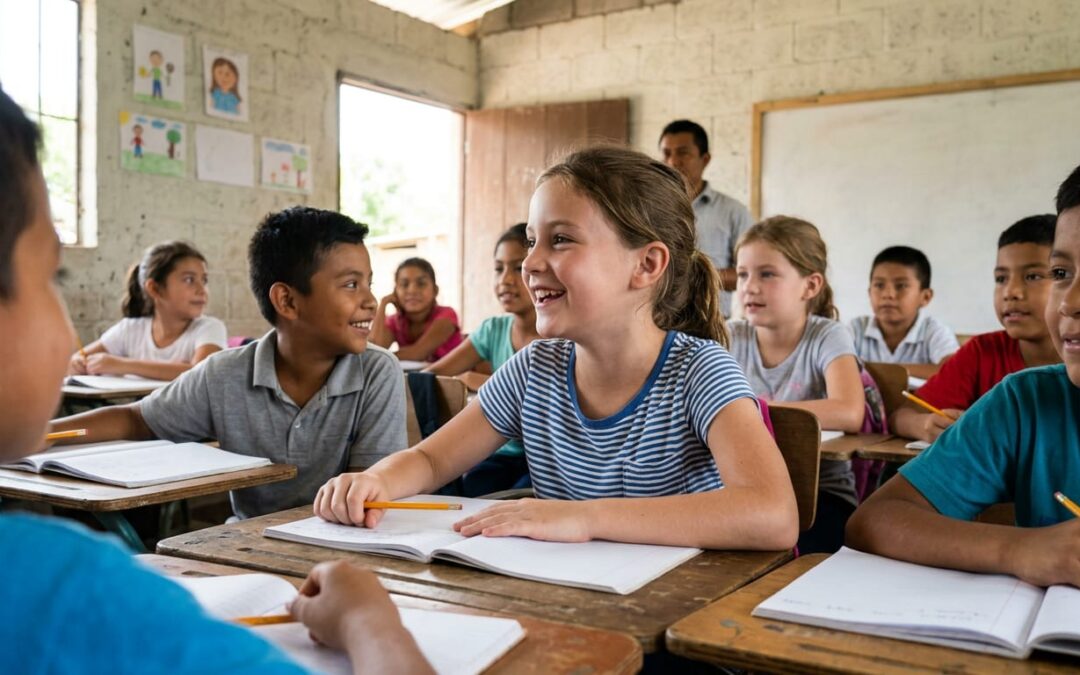
Education funding opens doors for children that stay closed without it – doors to better health, greater economic stability, and a broader sense of what their lives can become. The research is striking: a 10% increase in per-pupil spending for low-income children over 12 years was associated with a 7% rise in high school graduation rates and nearly a 10% increase in adult wages, according to the Learning Policy Institute. That is not a small ripple – it is a measurable shift in the direction of a life. Impact Others Inc. supports education as one of its core humanitarian programs, funding work through trusted partners who manage programs on the ground in communities where that shift is desperately needed.
What does education funding actually change for a child?
Education funding changes the most basic calculus of a child's daily life – whether they go to school at all, whether they stay, and whether what happens inside a classroom is worth the walk to get there.
For children in under-resourced communities, the barriers are rarely about motivation. They are about access: no school nearby, no materials, no teacher who stays, no meal that makes concentration possible. When funding addresses those specific gaps, the outcomes compound.
The Learning Policy Institute found that for low-income children, a 21.7% increase in per-pupil spending throughout all 12 school-age years was enough to eliminate the education attainment gap with children from higher-income families and raise graduation rates by 20 percentage points. That figure matters because it shows the gap is not fixed – it responds to sustained investment.
The benefits extend beyond the individual child. When a child gains access to education, the effects can reach their family and community over time: more stable income, better health decisions, stronger local economies. Education is not a single gift – it is a multiplier.
How does international education funding reach children who need it most?
The most honest answer to this question involves being clear about the gap between funds raised and programs delivered – and how that gap gets bridged responsibly.
One donor who traveled with Impact Others to a feeding center described what she found when she arrived: "Impact Others has done the hard job. They find the places with the right infrastructure, with the right means, and we just come and give a little part of us and make a bigger impact in every place." That observation points to something structural. Impact Others is not asking donors to trust an abstraction – it is building a model where the vetting, the relationships, and the operational groundwork are already in place before a dollar is spent or a visitor arrives. For donors who want to go further, the option to travel with Impact Others to the communities their support reaches makes that accountability visible firsthand.
Impact Others Inc. raises funds from donors and sends them directly to trusted local partners who manage education-related programs in the field. Those partners have the relationships, the local knowledge, and the infrastructure to run programs that actually reach children. Impact Others maintains independent bookkeeping, receives regular project updates from those partners, and communicates progress back to donors.
This model matters because, as the World Bank has noted, increasing school resources alone is not enough to improve learning outcomes. The quality of implementation, the trust of the community, and the fit between a program and its context all determine whether funding becomes impact. Partnering with people who are already embedded in those communities is how Impact Others addresses that problem.
Donors who give to education projects through Impact Others receive updates on the progress being made by local partners in the field – not abstract summaries, but real information about what is happening on the ground.
What does it mean to give to education alongside other humanitarian needs?
Education is one of the core areas of humanitarian need that Impact Others Inc. supports, alongside clean water, food, orphanages, and business opportunities. Those programs are not separate silos – they reinforce each other.
A child who is hungry cannot concentrate in a classroom. A child without clean water near home may spend hours fetching it instead of attending school. A child in an orphanage without safety and stability has no foundation on which learning can build. Giving to education through Impact Others is giving into a system of care, not a single isolated program.
Mindy Tibbs, an Impact Others partner for about four years, put the decision plainly: "When I think about Impact Others, I picture my own children in a third-world country. If a business owner had the answer to what my child needed – whether it was clean water from a well, a sewing center, food, an orphanage, housing, or any of the other life-changing resources – would they give? That's why I partner with Impact Others. It's making a real difference."
That framing – what would I want for my own child – is exactly the kind of compassion that moves education funding from a line item to a purpose.
Is education funding worth it when so many other needs compete for donor dollars?
This is the real question most donors are sitting with, even if they do not phrase it this way. The answer is yes – and the data supports the conviction.
Spending an additional amount per student in grades four through seven led to a meaningful rise in college enrollment and degree completion, according to the American Economic Association. These are not projections – they are measured outcomes from real children.
UNESCO reports that only four in 10 countries meet the 4% of GDP benchmark for education spending. That gap is where international education funding finds its purpose. Donors are not supplementing well-resourced systems – they are filling a structural absence.
The real estate developers who became Impact Others partners after a trip to Guadalajara described it this way: "The great thing is you actually get to see the incredible work being done around the world. For us, it was a natural fit to become an Impact Others partner." Seeing the work firsthand changed how they understood the stakes – and their giving followed.
When you give through Impact Others Inc., you can see exactly where your support goes – because we take donors to the places your giving changes.
What does giving to education through Impact Others look like in practice?
Giving to education through Impact Others means funding a program that a trusted local partner is already running – with the community knowledge, the relationships, and the operational capacity to deliver it well. It means your donation does not get absorbed into overhead before it reaches a child. And it means you can stay connected to what your giving is doing, through updates from the field and, for those who want to go further, through the option to travel with Impact Others to the communities your support reaches.
If you want to give to education or any of the other programs Impact Others funds, reach out directly. The team is available by phone at 2196780669, by email at info@impactothers.com, or by mail at 5885 Cumming Hwy Ste 108347, Sugar Hill, GA 30518. You can also visit the Impact Others Inc. education and humanitarian programs page to learn more about where your support goes and what it makes possible.
FAQ
Who decides how education funds are used once a donation is made?
Trusted local partners on the ground manage education-related programs and their own expenses. Impact Others Inc. raises the funds, sends them directly to those partners, and receives regular project updates. Donors are not funding an administrative layer – they are funding the program itself, delivered by people with the community relationships to make it work.
Which children does international education funding through Impact Others reach?
Impact Others funds humanitarian work in multiple countries, including Ghana, Nigeria, Honduras, India, Egypt, Colombia, and Thailand. Education is one of the core program areas supported alongside clean water, food, orphanages, and business opportunities. The specific communities reached depend on where trusted local partners are operating active programs.
How is education funding different from giving to food or water programs?
Each program addresses a different but connected need. A child without food cannot concentrate in school; a child without safe water may spend hours collecting it instead of attending class. Education funding works best when it is part of a broader system of care – which is exactly how Impact Others structures its humanitarian work. Donors can give to education specifically or support multiple program areas.
What makes education funding more impactful than a one-time gift?
The research is consistent: sustained investment over time produces the strongest outcomes. The Learning Policy Institute found that eliminating the education attainment gap for low-income children required consistent per-pupil investment across all 12 school-age years. Recurring giving – rather than a single donation – mirrors the kind of sustained support that produces those measurable results.