
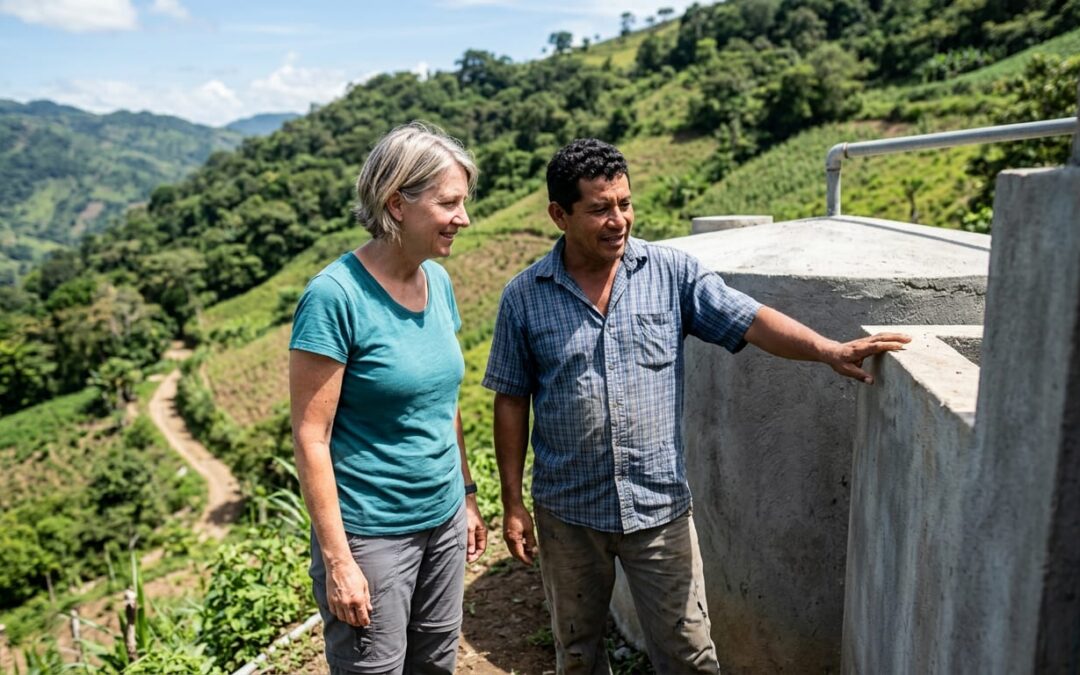
Most donors give and then wonder – did it actually reach anyone? Donor site visits are the answer to that question. A site visit is when a donor or funding organization travels to a project's location to meet the staff, the local partners, and the people the work serves. For organizations like Impact Others Inc., these visits transform giving from an act of faith into a firsthand experience – one where you see water flowing, children eating, and small businesses running because of what donors made possible.
What Actually Happens During a Donor Site Visit?
According to the Council on Foundations via Forefront's Library, a site visit occurs when a donor organization visits a donee organization at its office location or area of operation and meets with staff, directors, or recipients of services. In practice, that means you are not looking at a spreadsheet or a slide deck – you are standing where the work happens.
For Impact Others Inc., a site visit might mean trekking into the mountains of Honduras to see a water cistern project, visiting a feeding center in Nigeria, or meeting widows in West Africa who used small business funding to build economic independence. One donor who traveled to Honduras described crossing four rivers to reach a mountain community – and spending his first night in tears after meeting children at a feeding center and hearing the stories behind the work.
"The impact that's been made here is just outstanding," said one donor who made the trip. "Anything and everything you can give will go to the utmost use here."
That is what a site visit is: not a tour, but a transformation.
How Do You Prepare for a Nonprofit Site Visit?
Preparation matters – both for you and for the organization hosting you. According to Philanthropy Massachusetts, a site visit should be confirmed 24 to 48 hours in advance. And according to Philanthropy Massachusetts' funder guide, funders are advised to share expectations in advance – including the format, what information should be covered, who they would like to meet, and an agenda with questions to expect.
For Impact Others Inc. donor trips, practical preparation involves travel logistics, but also a mental shift: you are going as a partner, not an inspector. You will meet local team members who manage the projects day to day. You will see communities – not as problems to be solved, but as people building something with the support your giving helped provide.
One practical note from the RSF Foundation's donor guide: try to keep a formal site visit focused and brief to respect the organization's time and the community's. Impact Others Inc. donor trips go deeper than a single structured meeting – but the principle holds: come with focus, come with respect, and come ready to listen more than you talk.
What Is the Difference Between a Donor Trip and a Standard Site Visit?
A standard site visit – the kind a foundation or institutional funder conducts – is typically a structured, time-limited meeting at a project location. A donor trip goes further. It is a multi-day experience where supporters travel with the organization, visit multiple project sites, and build a real relationship with the mission.
| Type | Duration | Who It's For | What You See |
|---|---|---|---|
| Donor trip | Multi-day | Individual supporters, recurring donors | Multiple projects, communities, partners |
The key takeaway: a donor trip is the deeper version of a site visit – designed not just to verify impact, but to make you feel it.
Impact Others Inc. takes donors on trips to project locations in countries including Honduras, Ghana, Nigeria, India, Egypt, Colombia, and Thailand. These are not polished press tours. You see the water cisterns, the feeding centers, the orphanages, the small businesses – and you meet the people who run them and the people whose lives have changed because of them.
For donors who want to go beyond donor trips to visit communities as a concept and actually experience one, these trips are the most direct path to that kind of connection.
How Does a Site Visit Build Trust With an Organization?
Trust in a nonprofit is not built by reading a mission statement. It is built by seeing whether what an organization says matches what it does – on the ground, in the communities it serves.
When you visit a feeding center in Ghana that provided medical and vision care to more than 2,100 people in a single week-long outreach clinic, you are not taking anyone's word for it. When you meet seven widows in Nigeria who received funding in 2025 to launch small businesses and are now building toward long-term economic independence, you understand the scope of what a single project can do. When you see 23,136 children reached through a single Christmas initiative across more than 13 countries and the United States, the scale becomes real in a way a newsletter never could.
That is the function of a site visit: it converts trust from something you extend on faith into something you hold as a witness.
Impact Others Inc. connects donors with trusted local partners worldwide so every act of generosity reaches the people who need it most. The site visit is how donors confirm that connection is real – not through paperwork, but through presence.
For donors exploring nonprofit donor partnership as a genuine model rather than a marketing phrase, the site visit is the proof of concept.
What Should You Expect After the Visit?
A site visit is not the end of the relationship – it is usually the beginning of a deeper one. Donors who travel with Impact Others Inc. return home with photographs, memories, and a clarity about their giving that no amount of digital communication can replicate. Many become more consistent supporters, not because they were asked to, but because they saw exactly what their generosity makes possible.
If traveling to a project site is not possible right now, Impact Others Inc. shares photos and documentation of project progress so supporters stay connected to the work between visits. The organization sends 100% of project-related donations directly to the project, with administrative expenses kept very low compared to most nonprofits – so the giving itself is already doing more than it would elsewhere.
If you want to choose which project my donation supports before or after a visit, Impact Others Inc. makes that possible too, giving you a direct line between your generosity and a specific need.
Checklist
- Confirm logistics 24 – 48 hours before any site visit – whether you are traveling internationally or attending a local event with the organization.
- Prepare questions in advance about the specific projects you fund: who manages them, how progress is tracked, and what the community's role is.
- Go as a partner, not an auditor – the most meaningful site visits happen when donors come ready to listen and learn, not just verify.
- Ask about the local partners who run the projects day to day; understanding their role is key to understanding how a humanitarian nonprofit donor trip actually works.
- Document what you see with photos and notes so you can share the experience with others who might want to give or join a future trip.
- Follow up with the organization after your visit to stay connected to the specific projects you witnessed – and to ask how you can deepen your involvement.
FAQ
Who typically goes on nonprofit donor site visits – is it only major donors?
Donor site visits are not reserved for large institutional funders. Organizations like Impact Others Inc. take individual supporters – including recurring monthly donors – on trips to project locations in countries like Honduras, Ghana, and Nigeria. The goal is to connect any donor who wants a firsthand experience with the communities their giving supports, regardless of the size of the gift.
Which projects can donors visit through Impact Others Inc.?
Donors can visit a range of humanitarian projects, including clean water installations, feeding centers, orphanages, and small business development programs. Impact Others Inc. has active projects in Honduras, Ghana, Nigeria, India, Egypt, Colombia, and Thailand, as well as foster care and toy drive work in the United States. The specific sites available for a given trip depend on the timing and logistics of each journey.
How is a donor site visit different from just receiving project updates?
Project updates – photos, written summaries, documentation – give you a picture of the work. A site visit puts you in it. You meet the local partners who manage the projects, the community members who benefit from them, and you experience the geography and conditions firsthand. Donors who have traveled to Honduras with Impact Others Inc. describe the experience as something that changed them personally, not just informed them.
What does it cost to join a donor site visit trip with a humanitarian nonprofit?
Travel costs vary depending on the destination, the duration of the trip, and the logistics involved. What drives the cost is primarily the destination country, airfare, accommodations, and any in-country transportation – not a fee charged by the organization for access. The best approach is to contact Impact Others Inc. directly to ask about upcoming donor trips and what the travel logistics typically involve for a specific region.
Where do Impact Others Inc. donor trips actually go right now in 2026?
As of 2026, Impact Others Inc. has funded and overseen projects in Honduras, Ghana, Nigeria, India, Egypt, Colombia, Thailand, and the United States. Donor trips are organized to locations where active projects are underway, so the destination depends on which projects are in progress and accessible at the time of the trip. Reaching out to the organization directly is the best way to find out what trips are being planned and which project sites will be included.
Ready to stop wondering and start witnessing? Impact Others Inc. welcomes donors who want to see the work firsthand. Reach out to learn about upcoming donor trips and the projects your giving already supports. You can call 2196780669, email info@impactothers.com, or write to 5885 Cumming Hwy Ste 108347, Sugar Hill GA 30518. The people and the projects are real – and the door is open.