
Teaching kids about humanitarian giving works best when the giving is tied to something concrete they can see and understand – a specific project, a real place, a tangible outcome. Abstract concepts like "people in need" rarely land with children the way a water project, a toy drive, or a feeding center does. Research supports this: a University of Canterbury study involving 150 children ages 4 to 8 found that fewer than 20 percent were aware of the cause area they were being asked to support – which means most children are giving without knowing what their gift actually does. Connecting the act of giving to a visible outcome changes that. Impact Others Inc. connects everyday supporters with humanitarian work around the world, giving each gift a clear purpose and a real outcome to stand behind – and that same clarity is exactly what makes giving meaningful for children.
What Are the Most Effective Ways to Introduce Kids to Giving?
Children engage most deeply with giving when they can see a concrete outcome rather than contribute to an abstract fund. The following approaches move from awareness to action in ways that match how kids actually think and learn.
-
Start with a specific project, not a general cause. "Children are hungry in Honduras" is hard to hold. "This feeding center serves kids who need a meal every day" is something a child can picture. Toy drives and food drives give families a tangible, easy-to-explain starting point.
-
Let them choose where their giving goes. When a child picks a water project over a toy drive, or a feeding center over an orphanage fund, they develop ownership over the decision. That ownership is what builds a lifelong habit.
-
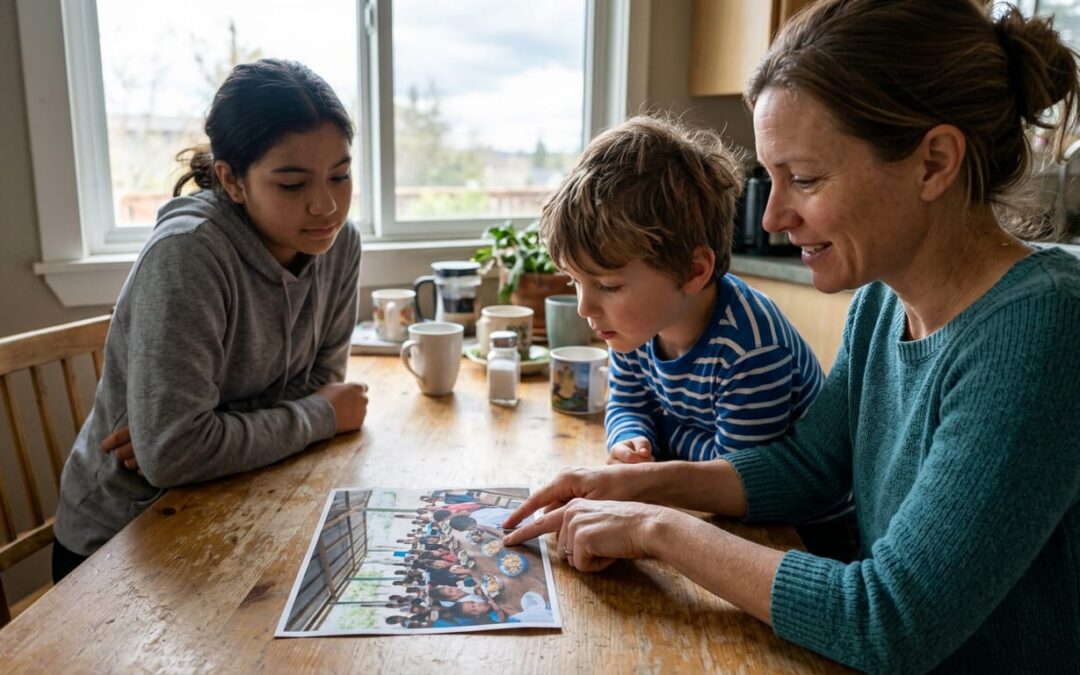
Make the giving visible. A jar on the counter, a printed photo of the project, or a map showing where the country is – these small anchors keep the giving real between contributions.
-
Talk about it out loud. The Indiana University Lilly Family School of Philanthropy found that parents who discuss charitable giving with their children make those children 20 percent more likely to give to charity than children whose parents do not have those conversations. The conversation itself is the lesson.
-
Connect giving to a story, not a statistic. Share project updates as a family. When a child hears that a water cistern was completed in a mountain community in Honduras, and that families now have clean water they didn't have before, the gift becomes a memory – not just a transaction.
-
Match the scale to the child's world. A teenager can understand a sewing center that helps a woman start a small business. A seven-year-old connects more readily with "kids who needed food got a meal today." Scale the story to the age.
Why Seeing a Concrete Outcome Matters So Much for Young Donors
Children engage with giving the same way they engage with everything else: through direct experience and visible cause-and-effect. When the outcome of a gift is invisible, the motivation to give again weakens over time. When the outcome is something they can picture – or better yet, see – the connection holds.
This is one reason that families who have traveled to project sites often describe a shift that is difficult to explain until you witness it yourself. One donor who visited a feeding center in Honduras put it plainly: "I feel like it's very difficult to have a complete understanding until you physically put your hands on it." That same principle applies to children. Sharing photos from a project visit, watching a short video update, or even looking at a map together gives a child something concrete to hold onto.
The United Nations Foundation has documented that nearly 9 out of 10 American youth ages 8 to 19 gave money to charitable causes – which means the impulse to give is already present in most young people. The question is not whether to cultivate it, but how to direct it toward something meaningful enough that it deepens rather than fades.
How Does a Family Actually Start This Conversation?
The most common barrier is not reluctance – it is not knowing where to begin. A few practical starting points:
For younger children (ages 5 – 10): Begin with something physical. A toy drive is one of the most accessible entry points because children understand toys. Asking a child to choose one toy to give to another child who doesn't have one creates empathy through action, not instruction.
For older children and teenagers (ages 11 – 17): Teenagers respond to complexity and agency. Explaining that a sewing center helps a woman in Colombia start her own small business – and that a donation made that possible – connects giving to outcomes that feel real and lasting. One donor who became involved after her 17-year-old completed a mission trip described the moment her family committed to deeper involvement: "We looked at each other and said, 'Oh my God, we really need to get heavily involved in being a partner and being part of this greater thing.'" That shift from passive awareness to active partnership is exactly what families are looking for when they want giving to mean something.
For the whole family: Choose one project together and follow it. When giving becomes a shared family practice – something discussed at dinner, tracked on a map, returned to over months – it stops being a one-time event and becomes part of how the family understands itself.
What Should Families Look for in a Humanitarian Organization When Giving With Kids?
When introducing children to giving, the organization you choose matters as much as the conversation you have. A few things worth looking for:
Transparency about where the money goes. Children ask direct questions: "Did my money actually help?" Being able to answer that honestly requires choosing an organization that is clear about how funds are used. Impact Others Inc. sends 100 percent of project-related donations directly to the project, with administrative expenses kept deliberately low – which means a family can tell a child that their gift went to the work, not overhead.
Projects children can picture. Clean water, food, orphanages, toy drives, and small business support are all programs children can understand at some level. Abstract institutional language does not land with kids; specific programs do.
A connection to real places and real people. Organizations that take donors to project sites – so families can see the work firsthand – offer something no brochure can replicate. When a teenager walks into a feeding center or sees a water cistern that a community now relies on, the experience becomes a reference point they carry for years. That kind of accountability is visible rather than theoretical.
Mindy Tibbs, an Impact Others Inc. partner for about four years, described the frame she uses when she thinks about giving: "When I think about Impact Others, I picture my own children in a third-world country. If a business owner had the answer to what my child needed – whether it was clean water from a well, a sewing center, food, an orphanage, housing, or any of the other life-changing resources – would they give?" That question is one worth asking alongside your children, too.
Raising Kids Who Give: Where Does the Habit Actually Form?
Teaching children about humanitarian giving is less about a single lesson and more about a pattern of small, consistent conversations tied to real outcomes. The habit forms when giving is specific, when the outcome is visible, and when the family returns to it together over time.
For families looking for a place to start, the Impact Others Inc. Partner Guide offers a practical introduction to the programs, the projects, and the ways families at every stage of giving have found their footing.
If you'd like to learn more or find a project that fits your family's values, reach out directly: call 2196780669, email info@impactothers.com, or write to 5885 Cumming Hwy Ste 108347, Sugar Hill, GA 30518. The conversation is always worth starting.
FAQ
Who benefits most from learning about humanitarian giving as a child?
Every child benefits from understanding that their actions can improve someone else's life, but research from the Indiana University Lilly Family School of Philanthropy suggests children whose parents discuss giving actively are 20 percent more likely to give as adults. Children who connect giving to a specific, visible outcome – a feeding center, a water project, a toy drive – tend to develop the strongest and most lasting sense of compassion and purpose around generosity.
Which types of humanitarian projects are easiest for kids to understand?
Projects with a clear, physical outcome are easiest for children to grasp. Toy drives resonate with younger children because they understand what a toy means to another child. Feeding programs, clean water projects, and orphanage support are also concrete enough that a child can picture the difference a contribution makes. Abstract fund names or institutional programs are harder to explain and less likely to hold a child's attention or empathy over time.
How do you keep a child's interest in giving going beyond the first donation?
Follow the project together. When families share updates – photos from a site visit, a note about a feeding center that is still running, a story about a community that now has clean water – giving becomes a continuing story rather than a completed transaction. Returning to the same project over months, or choosing a new one together each year, builds the rhythm that turns a single act of generosity into a genuine family value.
Where can a family go to see humanitarian projects in person?
Impact Others Inc. takes donors on trips to project sites in countries including Honduras, Ghana, Nigeria, India, Colombia, Egypt, and Thailand. These visits allow families – including teenagers – to see feeding centers, water projects, orphanages, and small business programs firsthand. Families who have made these trips frequently describe the experience as the moment their children's understanding of giving changed from abstract to real.