
Verifying a charity's impact claims before donating comes down to three layers: independent financial audits, third-party ratings, and direct observation. No single layer is enough on its own – the organizations worth trusting can hold up under all three. Impact Others Inc. is built around exactly that standard, offering donors a path from skepticism to confidence through transparency they can see for themselves.
If you've been burned before by vague "impact stories" with no supporting evidence, that instinct to dig deeper is worth following. Here's how to do it methodically.
What Are the Most Reliable Ways to Verify a Charity's Impact Claims?
Verification is most reliable when it stacks multiple independent sources rather than relying on one. A charity that passes all of these checks has earned a higher level of trust than one that only passes some.
One group that traveled with Impact Others Inc. to Brazil came back with a perspective that no audit can fully capture. A participant wrote: "Thank you for giving us an experience we will never forget. The smiles and joy of the children, and the opportunity to bring a little comfort and kindness to the seniors, touched our hearts deeply. We came to Brazil hoping to make a difference, but we feel like we received so much more than we gave. This experience has reminded us how powerful kindness, compassion and simply showing up for others can be. Thank you for allowing us to be part of something so meaningful. We're leaving with beautiful memories and a desire to continue making a difference. We hope this is just the beginning of many more journeys together." That kind of direct witness – seeing the children, meeting the seniors, being present in the community – is something a spreadsheet cannot replicate. It is also something only an organization with nothing to hide will offer.
That firsthand access sits alongside the documentary checks that should anchor any serious evaluation:
-
Request the most recent audited financial statements. An independent CPA audit – not just an internal review – examines whether the organization's financials accurately represent its activities. Ask specifically for the audit letter, not just the summary. If the charity won't share it, that tells you something.
-
Look up the Form 990 on ProPublica Nonprofit Explorer or Candid (GuideStar). The IRS requires most nonprofits to file a Form 990 annually, which discloses revenue, expenses, executive compensation, and program spending. This is public information and available for free. Pay attention to the ratio of program expenses to total expenses – a higher percentage going to programs rather than overhead is a meaningful signal.
-
Check third-party rating platforms. Charity Navigator's impact methodology pairs measurable outcomes with the specific costs required to achieve them, giving donors a more grounded picture than narrative-only claims. Candid and the Better Business Bureau's Wise Giving Alliance also publish assessments based on governance, transparency, and financial health.
-
Verify public charity status with the IRS. A publicly supported charity must generally receive at least one-third of its total support from governmental units, the general public, and other public charities – a threshold the IRS measures over a five-year period. Confirming a charity meets this test is a baseline check that takes about two minutes on the IRS Tax Exempt Organization Search tool.
-
Look for project-level documentation. Photos, field updates, and partner narratives that connect to specific projects – not just general mission statements – are a sign that accountability extends past the organization's front office.
-
Ask whether you can visit. A charity willing to take donors to project locations has nothing to hide. That offer is itself a form of verification.
Does a Charity's Administrative Expense Ratio Actually Tell You What You Think It Does?
The overhead ratio – the percentage of donations going to administrative costs versus programs – is useful but often misread. A very low overhead number isn't automatically good, and a moderate one isn't automatically bad.
What matters more is whether the charity can demonstrate that its program spending produced verifiable outcomes. An organization spending a significant share on administration but delivering documented, audited results may be more trustworthy than one claiming minimal overhead with no documentation to back up what the rest accomplished.
That said, overhead ratios do reveal priorities. Impact Others Inc. keeps administrative expenses far lower than most nonprofits, and 100% of project-related donations go directly to the projects themselves. That structure means donors aren't subsidizing a large internal bureaucracy – they're funding work on the ground, managed by trusted local partners who handle project delivery and submit their own documentation.
When you're comparing organizations, ask what the overhead ratio actually includes. Some charities classify fundraising costs as "program expenses," which inflates their apparent efficiency without changing where the money actually goes.
What Does Firsthand Verification Actually Look Like for a Donor?
Reading audits and checking ratings are necessary, but they have a ceiling. They tell you what an organization claims, and whether that claim is consistent with its financial records. What they can't tell you is whether the work is real, whether the people it's meant to serve are being reached, or whether the local partners are operating with integrity.
That's where direct observation becomes the most powerful verification tool available to a donor.
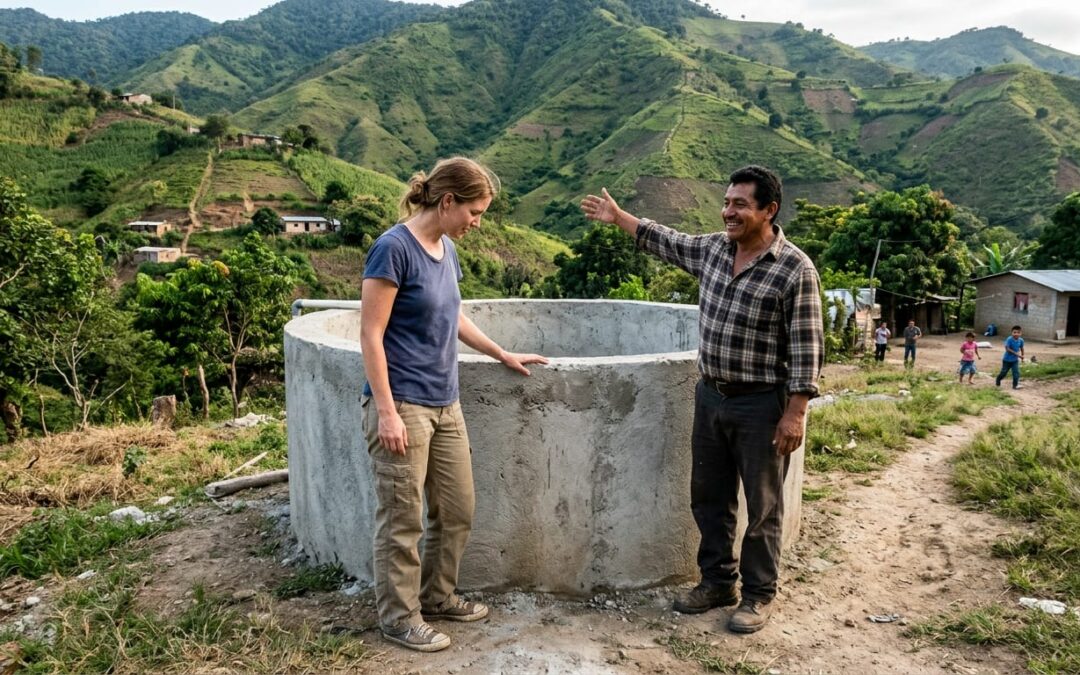
One donor who joined Impact Others Inc. on a trip to Honduras described crossing four rivers to reach a remote mountain community, visiting a water cisterns project, and meeting children at a feeding center. "I feel like it's very difficult to have a complete understanding until you physically put your hands on it," he said. "Anything and everything you can give will go to the utmost use here." That kind of firsthand confirmation doesn't come from a spreadsheet.
Rob and Bernice, who became Impact Others partners after meeting the organization's leadership directly, put it this way: "After meeting Eddie and seeing the integrity, the sustainability, and the boots-on-the-ground work – drilling wells, supporting feeding centers, and creating sewing centers – we decided to become partners. Their integrity and their desire to help people around the world who are living in unfortunate circumstances really connect with us."
The willingness to bring donors into the field isn't a marketing gesture. It's a structural commitment to accountability. When an organization invites you to see the work yourself, verification shifts from paperwork to reality.
How Do You Compare Charity Verification Standards When Choosing Between Organizations in 2026?
Choosing between organizations isn't just about which one has the best ratings – it's about which verification methods each organization actually supports.
| Verification Method | What It Confirms | Limitation |
|---|---|---|
| Independent financial audit | Accuracy of financial records | Doesn't confirm field-level outcomes |
| Form 990 (public filing) | Revenue, expenses, executive pay | Self-reported program descriptions |
| Third-party ratings | Governance, transparency, financial health | Varies by methodology and data freshness |
| Project photos and field updates | Activity is occurring | Can be staged or selectively presented |
| Donor site visits | Real, firsthand confirmation | Requires organization willingness and access |
The strongest verification combines financial documentation with direct observation. An organization that supports all five methods is categorically more verifiable than one that only supports two or three.
When you verify nonprofit impact data before committing a grant, the questions you ask early in the process shape what evidence you're able to collect later. And if you're directing funds through a Donor-Advised Fund, the bar for verification is worth raising further – DAF grants carry fiduciary weight, and the organizations that welcome that scrutiny are the ones worth finding.
What Does a Trustworthy Charity Actually Look Like?
A trustworthy charity doesn't just claim impact – it creates conditions where donors can check the claim independently, and it welcomes that process rather than resisting it.
Through trusted local partners, Impact Others Inc. delivers clean water, food, education, and hope to communities around the world on behalf of supporters who want to make an impact. The organization's model keeps the verification path open at every level: financial documentation maintained by independent bookkeeping, project progress communicated to donors, and site visits available so donors can see the work firsthand.
Mindy Tibbs, a four-year Impact Others partner, described the decision this way: "When I think about Impact Others, I picture my own children in a third-world country. If a business owner had the answer to what my child needed – whether it was clean water from a well, a sewing center, food, an orphanage, housing, or any of the other resources – would they give? That's why I partner with Impact Others. It's making a real difference."
If you're at the point where you want to move beyond trusting a charity's own narrative, the How It Works page and About page on the Impact Others Inc. website walk through the transparency practices, the local partner model, and how donor site visits are structured – so you can evaluate the verification framework before you give.
The organizations worth trusting are the ones that make verification straightforward. If a charity makes it hard to check their work, that's the answer.
Reach out to Impact Others Inc. directly at info@impactothers.com, call 2196780669, or write to 5885 Cumming Hwy Ste 108347, Sugar Hill GA 30518. The conversation about where your giving goes is one they're ready to have.
FAQ
How do I find out if a charity has been independently audited?
Ask the organization directly for its most recent independent audit – specifically the auditor's letter and the full financial statements, not just a summary. Many nonprofits above a certain revenue threshold are required by federal law to undergo an independent audit. You can also check the charity's Form 990, filed annually with the IRS and available free on ProPublica Nonprofit Explorer or Candid, to see whether an audit is referenced in the filing.
Which third-party rating systems are most useful for evaluating a nonprofit's transparency?
Charity Navigator, Candid (formerly GuideStar), and the BBB Wise Giving Alliance each use different methodologies. Charity Navigator pairs measurable outcomes with costs, making it useful for impact comparisons. Candid focuses on organizational transparency and governance. The BBB Wise Giving Alliance evaluates against 20 standards covering finances, governance, and donor communications. Using two or more of these together gives a more complete picture than relying on one alone.
Who is responsible for verifying that a charity's local partners are actually delivering the work?
The nonprofit that receives your donation is responsible for monitoring its local partners. When evaluating an organization, ask specifically how it monitors partner activity – what documentation partners submit, how often, and what happens if a partner fails to deliver. Organizations that maintain independent bookkeeping, receive regular field documentation, and invite donors to visit project sites are demonstrating that monitoring is active, not just assumed.
What should I look for in a charity's impact documentation to tell if it's credible?
Credible impact documentation connects specific inputs (dollars spent, resources deployed) to specific, measurable outputs (number of people served, wells drilled, meals provided) in identifiable locations. Vague language like "thousands of lives touched" without supporting data is a warning sign. Look for documentation that names the project, the location, the partner responsible, and the documented outcome – and that acknowledges what didn't go as planned, since no organization operates without setbacks.
Where can I go to see a charity's humanitarian work in person before committing a major grant?
Some nonprofits, including Impact Others Inc., offer donor site visits to active project locations. These trips allow donors to meet the local partners, see the infrastructure firsthand – water systems, feeding centers, small business programs – and speak directly with community members. If an organization you're considering doesn't offer or support site visits, ask why. A willingness to open project locations to donor observation is one of the strongest signals of organizational integrity available.