
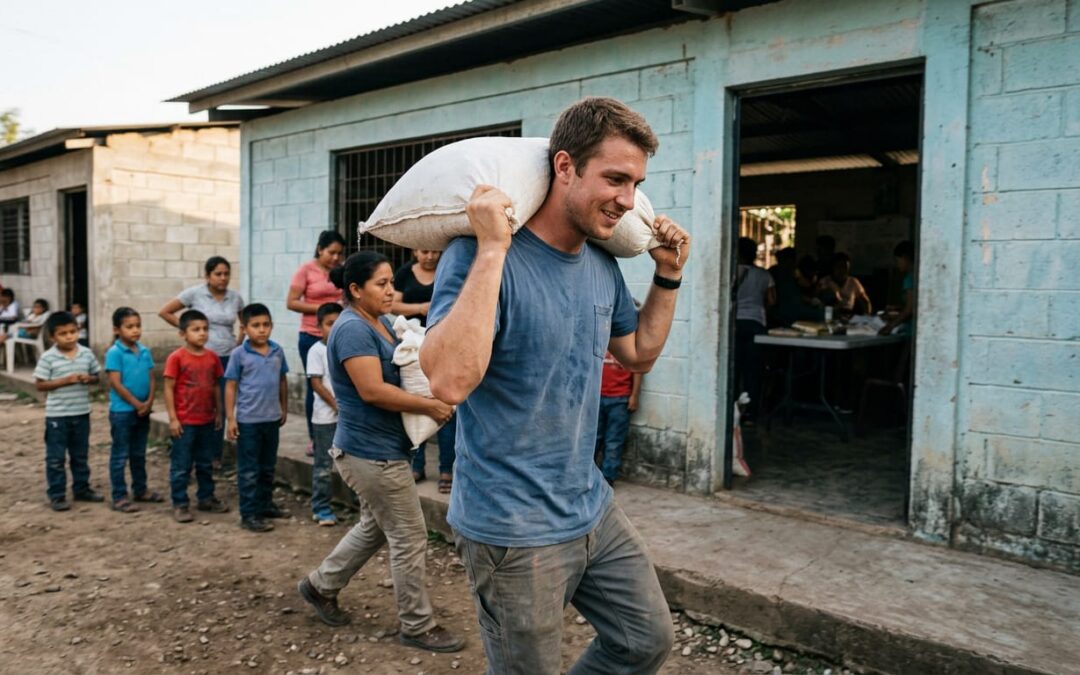
Monthly giving helps nonprofits plan better than one-time donations because it creates a predictable funding base – and predictability is what allows humanitarian projects to operate continuously rather than in bursts. When local partners know funds are arriving on a consistent schedule, they can commit to ongoing work: staffing feeding centers, maintaining clean water systems, and caring for children in orphanages without stopping to wonder whether next month's resources will appear.
Impact Others Inc. connects everyday supporters with humanitarian work around the world, giving each gift a clear purpose and a real outcome to stand behind. For the partners Impact Others funds in places like Honduras, Nigeria, Ghana, and India, the difference between a reliable monthly commitment and an unpredictable stream of one-time gifts shapes whether a program runs smoothly or scrambles.
How Does Predictable Funding Actually Change How Projects Run?
Predictable monthly funding removes the stop-and-start cycle that affects humanitarian work. When local partners can forecast their incoming resources, they plan staffing, purchase food in advance at better prices, schedule water system maintenance, and make longer-term commitments to the communities they serve.
One-time gifts, while genuinely meaningful, can create gaps between funding cycles that affect ongoing work. A feeding program that serves children every day cannot pause while an organization waits for the next donation campaign to close. The need is continuous – and so the funding that supports it works best when it is continuous too.
This is the operational reality behind monthly donation vs one-time gift decisions. A single gift is not without value. Ongoing programs – water access, daily meals, orphanage care, small business training – are structured around recurring costs, not one-time expenses. Monthly support aligns with how those needs actually exist in the world.
Recurring support also allows organizations like Impact Others to commit to partners with greater confidence. When Impact Others can project its incoming funds, it can make firmer commitments to the local teams managing projects on the ground, rather than holding back until a campaign hits its target.
What Do Donor Retention Numbers Say About Monthly Giving Right Now?
The retention data on monthly giving is one of the clearest arguments for the model. After one year, 71% of monthly donors across the sector remain active, compared with 24% of new one-time donors, according to Truesense's analysis of M+R Benchmarks 2026 data. That gap represents a fundamentally different relationship between donor and mission.
Monthly donors also tend to give more over time than one-time donors at a comparable single-gift level. A supporter who gives a modest amount every month for an extended period contributes far more to sustained project work than a one-time gift of a larger amount, because the cumulative total compounds alongside the continuity it creates.
Recurring giving schedules are dominated by monthly arrangements, which make up roughly two-thirds of all such schedules, and their share of total recurring revenue grew from 73% in 2021 to 84% in 2025, according to GivingTuesday's 2026 research. The sector has moved decisively toward monthly giving because organizations have seen, repeatedly, that it funds sustained work better than any other model.
Predictable income also reduces the time and resources spent on emergency fundraising – which means more organizational energy stays focused on the mission rather than on filling sudden budget gaps.
Does Monthly Giving Cost More Than a One-Time Donation?
The question of cost is worth addressing directly, because some supporters assume a monthly commitment means giving more than they intended. In practice, monthly giving is structured around whatever amount fits a supporter's budget – there is no minimum threshold that makes it worthwhile.
What changes is not the amount per gift but the pattern. A supporter who gives once provides that amount toward a project. A supporter who gives the same amount monthly provides a steadily growing total over a year, distributed across the programs that need consistent funding. The cost per month stays the same; the impact compounds because the continuity compounds.
For Impact Others, 100% of project-related donations go directly to the project – not to overhead, not to administrative costs. That means every dollar in a monthly commitment reaches the local partner managing the work. The question of value is not just how much is given but how reliably it arrives and how directly it travels.
| Giving Type | Annual Total | Predictability for Partners | Retention After 12 Months |
|---|---|---|---|
| One-time gift | Single contribution | None – unpredictable | ~24% give again |
| Monthly giving | Compounds over the year | High – partners can plan | ~71% still active |
Monthly giving at a modest level produces a meaningfully larger annual contribution and a far more dependable funding stream for the local teams doing the work.
Why Does Continuity Matter Specifically for Water, Food, and Orphanage Programs?
Clean water systems require ongoing maintenance, not a single installation. Feeding programs serve children every day, not once a season. Orphanage care is a year-round commitment to children who have nowhere else to turn. These are not one-time problems with one-time solutions – they are continuous needs that require continuous support.
A donor in Nigeria who now has access to clean water through a project Impact Others helped fund described the change simply: "We used to fetch water from this stream. It is polluted water with cattle and other animals. Now since we have this clean water we don't have to travel far to get the water." That outcome required sustained investment – not a single gift that arrived and then stopped.
The same logic applies to every program area. Education and small business opportunities require months of consistent support to produce lasting change. Toy drives depend on reliable funding to reach children living with hardship at the moments that matter. When monthly donors show up consistently, local partners can make promises to communities – and keep them.
One supporter who visited a feeding center in Honduras put it directly: "The work that they've done here is incredible from the water cisterns project that we visited and got to see to the amount of people that have been fed and continue to be fed on a daily basis, but there's still a ton more that needs to be done. And so if you have an opportunity to contribute, contribute. Anything and everything you can give will go to the utmost use here."
That "continue to be fed" phrase is the point. Continuity is the outcome – and monthly giving is what makes it structurally possible.
What Kind of Supporter Does Monthly Giving Suit Best?
Monthly giving suits supporters who want their compassion to show up consistently, not just when a campaign catches their attention. It is for people who think about the children in an orphanage not as a one-time cause but as an ongoing responsibility – and who want their giving to reflect that.
It is also for supporters who want their generosity to have a clear purpose rather than disappearing into a general fund. At Impact Others, monthly donors are partners in ongoing programs – water access, food security, orphanage care, education, and new business opportunities – that are running right now, in real communities, with real people counting on them.
Mindy Tibbs, who has been an Impact Others partner for about four years, described the shift in how she thinks about giving: "When I think about Impact Others, I picture my own children in a third-world country. If a business owner had the answer to what my child needed – whether it was clean water from a well, a sewing center, food, an orphanage, housing, or any of the other life-changing resources – would they give? That's why I partner with Impact Others."
That framing – picturing someone you love in the place of someone who needs help – is what turns a monthly commitment from a transaction into a partnership. The Compassion Donors monthly giving program at Impact Others is designed for supporters who are ready to make that shift.
Checklist
- Align your giving with how needs actually work – clean water maintenance, daily feeding programs, and orphanage care are ongoing costs, so monthly giving matches the structure of those needs rather than working against it.
- Start at an amount that fits your budget – monthly giving to a humanitarian nonprofit like Impact Others is not about a large single gift; it is about reliable, consistent support that local partners can plan around.
- Ask whether 100% of your donation reaches the project – Impact Others sends 100% of project-related donations directly to the local partner managing the work, with no portion diverted to overhead.
- Consider a site visit – Impact Others takes donors on trips to project locations so you can see the work firsthand, not just receive updates about it.
- Think in annual terms, not monthly terms – a modest monthly commitment compounds into substantial annual support and produces far higher retention and continuity than a single one-time gift.
- Look for programs that match your passion – whether that is food security, clean water, education, orphanage care, or new business opportunities, monthly giving works best when it is tied to a program that genuinely moves you.
FAQ
Why do nonprofits prefer monthly donations over one-time gifts?
Monthly donations create a predictable funding base that allows local partners to plan and sustain project work without interruption. One-time gifts are meaningful but unpredictable – they can leave gaps between funding cycles that affect ongoing programs like feeding centers and clean water maintenance. Predictable income also reduces the time organizations spend on emergency fundraising, keeping focus on the mission.
Who benefits most from a monthly giving program?
The communities served by ongoing humanitarian programs benefit most – children in orphanages, families relying on clean water systems, and people in food programs that run every day of the year. Monthly donors also benefit by building a consistent, purposeful giving practice rather than responding to individual campaigns. Organizations like Impact Others can make firmer commitments to local partners when monthly support is reliable.
Which type of giving produces more impact over time – monthly or one-time?
Monthly giving produces more cumulative impact over time for most supporters. A monthly gift compounds into a substantially larger annual total, distributed steadily across programs that need continuous funding. Monthly donors also stay engaged at a far higher rate – 71% of monthly donors remain active after 12 months, compared with about 24% of one-time donors, according to Truesense's analysis of M+R Benchmarks 2026 data.
How do I know my monthly donation is actually reaching the project?
Impact Others sends 100% of project-related donations directly to the trusted local partner managing the work. Administrative costs are kept deliberately low and are not drawn from project funds. Donors who want to go further can join a site visit trip to see project work in person – in Honduras, Nigeria, Ghana, India, or other countries where Impact Others partners operate.
What happens to a humanitarian project when monthly funding stops suddenly?
When predictable monthly funding stops, local partners face the same challenge any organization faces when a reliable income stream disappears – they may need to reduce staffing, delay maintenance, or scale back programs. For feeding centers and orphanage care, those delays have real consequences for the people being served. This is why monthly giving programs at nonprofits are designed to build a stable base of recurring support rather than relying on unpredictable campaign cycles.
If you are ready to become a steady partner in work that matters – whether that means clean water in Nigeria, food for children in Honduras, or care for kids in an orphanage in Mexico – Impact Others Inc. is here to connect your generosity to a clear purpose. Reach the team at info@impactothers.com, call 2196780669, or write to 5885 Cumming Hwy Ste 108347, Sugar Hill GA 30518.