Measuring humanitarian grant impact means looking beyond a nonprofit's word and finding concrete, verifiable evidence that your dollars reached real people and produced real change. For DAF holders and their advisors, that standard matters – because a grant that cannot be verified is, in practice, unverifiable. The most reliable approach combines on-the-ground documentation, independent evaluation criteria, and direct donor access to project sites.
What Does "Real Impact" Actually Mean for a Humanitarian Grant?
Real impact means a measurable change in someone's life that can be traced back to your grant. It is not a press release or a thank-you letter. Humanitarian evaluation frameworks have moved toward a defined set of criteria precisely because vague success stories are not enough.
According to the European Commission / ECHO, 2007, the OECD-DAC adapted its evaluation framework for complex humanitarian emergencies to seven criteria: relevance/appropriateness, connectedness, coherence, coverage, efficiency, effectiveness, and impact. Those seven dimensions give donors and advisors a structured way to ask whether a project actually reached the people it was meant to reach, whether it used resources well, and whether the change it produced will last.
Knowing that framework exists is useful. Knowing whether the organization you funded actually measures against it is the more important question – and that is where most donors run into a wall.
Which Indicators Actually Show a Grant Worked?
The strongest impact indicators combine direct reach (how many people received something) with indirect reach (how many benefited as a result) and at least one outcome-level measure showing the change that followed.
According to the Women's Peace & Humanitarian Fund, 2021, grantees are required to use at least one impact-level indicator alongside both direct and indirect reach indicators for global reporting. That standard – not just counting outputs, but tracking whether lives changed – is the bar a serious humanitarian organization should be able to meet.
For a DAF holder evaluating a nonprofit for a DAF grant, the practical translation looks like this:
| Indicator type | What it measures | Example |
|---|---|---|
| Direct reach | People who received the intervention | Families served by a clean water project |
| Indirect reach | People who benefited as a result | Community members sharing the same water source |
| Impact-level | Change in condition or behavior | Reduction in waterborne illness; children no longer missing school to carry water |
The key takeaway: a grant that only reports outputs (a well was built, meals were served) without any outcome evidence leaves a critical gap in the accountability chain.
Why Qualitative Evidence Matters as Much as Numbers
Numbers tell part of the story. Qualitative evidence – photographs, site visit observations, firsthand accounts from community members – tells the rest, and often more compellingly.
The HCT Monitoring and Evaluation Guidance, 2026 recommends that evaluations use both qualitative and quantitative methods, precisely because numbers alone cannot capture whether a change was meaningful to the people it affected.
A boy in Nigeria described the difference clean water made in plain terms: "We used to fetch water from this stream. It is polluted water with cattle and other animals. Now since we have this clean water we don't have to travel far to get the water. Thank you Impact Others for getting us this clean water." No metric captures that shift – the time saved, the health risk removed, the dignity restored – as directly as the person who lived it.
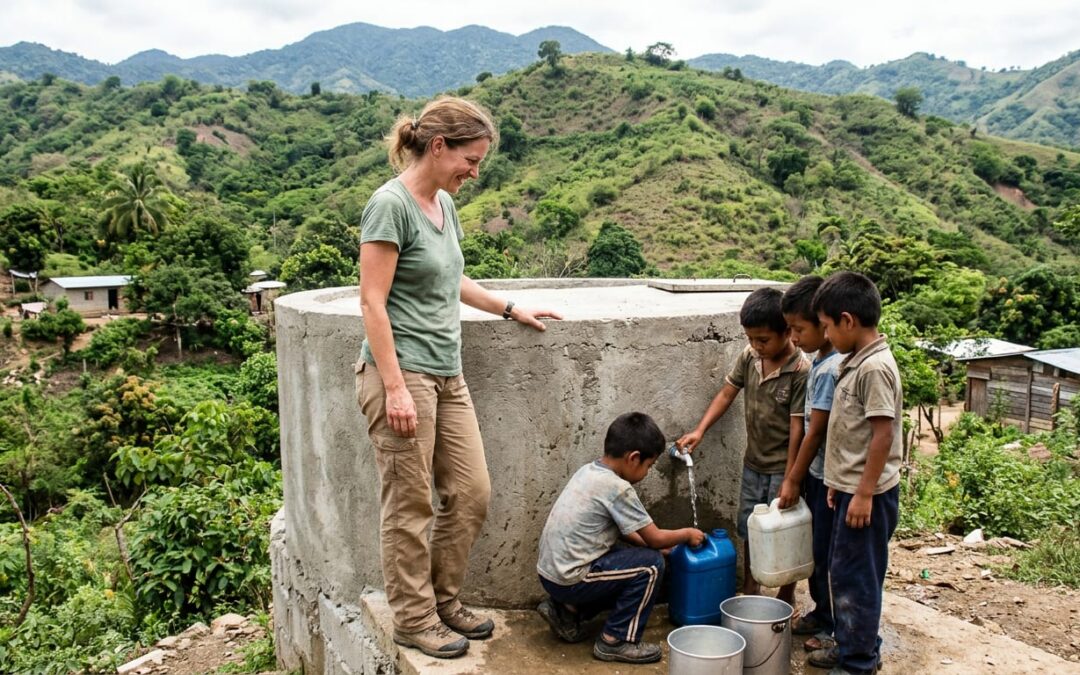
This is why donor site visits are not a bonus feature. They are an accountability mechanism. One donor who traveled to Honduras to see project work firsthand put it this way: "The impact that's been made here is just outstanding… I feel like it's very difficult to have a complete understanding until you physically put your hands on it." Another set of partners who visited Guadalajara noted: "One of the things we love about Impact Others is that you get to participate firsthand. You can be as involved as you want, but the great thing is you actually get to see the incredible work being done around the world."
Seeing the work with your own eyes is not sentiment. It is verification.
How Does Impact Others Inc. Make Grant Impact Verifiable?
Through trusted local partners, Impact Others Inc. delivers clean water, food, education, and hope to communities around the world on behalf of supporters who want to make an impact. The accountability model is built around a specific differentiator: 100 percent of project-related donations go directly to the project. Administrative costs are kept deliberately low, which means the grant does what it was intended to do rather than funding overhead.
Beyond the financial structure, Impact Others Inc. connects donors directly to the work. Partners receive project documentation, photographs, and the option to travel to project locations in countries including Honduras, Nigeria, and Mexico to observe progress firsthand. That direct access is what separates verifiable impact from impact that is simply claimed.
For financial advisors helping clients think through choosing causes for DAF grants, this matters practically: a grant recipient that allows – and actively invites – donor site visits is a grant recipient whose work can be independently confirmed. That is a meaningful difference when a client asks whether their giving produced a real result.
According to UNFPA, 2024, there is a consensus among UN agencies and other actors to use seven criteria of effectiveness, appropriateness, efficiency, impact, coverage, coherence, and connectedness or sustainability when evaluating humanitarian action. Organizations that take those criteria seriously build their programs to be evaluated, not just described.
How Do You Know Before You Grant – Not Just After?
The most effective way to know your grant will produce a verifiable result is to apply scrutiny before the grant is made, not only after. The questions worth asking a nonprofit in advance:
- What indicators do you track, and at what level – output, outcome, or impact?
- How are project results documented and by whom?
- Can donors visit project sites to see the work directly?
- What percentage of this grant reaches the project versus overhead?
- Who manages the project on the ground, and how do you maintain accountability with them?
An organization that can answer those questions specifically and consistently – not with marketing language, but with process detail – is one that has built its operations around accountability. That is the standard that purpose-driven giving deserves.
Can You Be Confident in Your Giving Before You Grant?
The question "did my grant produce a real result?" should have a real answer. Not a newsletter update, not a general mission statement – a documented, observable change in the lives of people the grant was meant to serve. The combination of rigorous evaluation criteria, both quantitative and qualitative evidence, and direct donor access to project sites is what makes that answer possible.
For DAF holders and advisors who want their philanthropic giving to be as intentional as the rest of their financial plan, the Impact Others Inc. Partner Program offers a structured way to give strategically, visit the work, and know – not assume – that the grant mattered.
To learn more or connect with the team, reach out directly: by phone at 2196780669, by email at info@impactothers.com, or by mail at 5885 Cumming Hwy Ste 108347, Sugar Hill, GA 30518.
Checklist
- Ask for impact-level indicators, not just output counts – request evidence of change (health outcomes, school attendance, income earned), not only delivery numbers (meals served, wells built).
- Request both quantitative data and qualitative documentation – photos, community accounts, and site observations fill the gaps that numbers alone cannot.
- Confirm what percentage of your DAF grant reaches the project directly – a nonprofit with low administrative overhead keeps more of your grant working in the field.
- Ask whether donors can visit project sites – an organization that actively invites site visits is one whose work holds up to direct observation.
- Apply the seven humanitarian evaluation criteria – relevance, coverage, efficiency, effectiveness, impact, coherence, and connectedness – as a pre-grant checklist before directing funds.
- Review how local partners are selected and held accountable – trusted local partners with independent oversight are the operational backbone of verifiable humanitarian giving.
FAQ
How do I evaluate whether a humanitarian grant actually reached the people it was meant to help?
Ask the organization for both direct reach indicators (how many people received the intervention) and impact-level indicators (what changed as a result). The Women's Peace & Humanitarian Fund requires grantees to report on all three: direct reach, indirect reach, and at least one impact-level measure. An organization that only reports outputs – "we built X wells" – without outcome evidence is leaving a significant accountability gap.
Which evaluation criteria should I use to judge humanitarian grant results?
The OECD-DAC framework adapted for humanitarian emergencies uses seven criteria: relevance/appropriateness, connectedness, coherence, coverage, efficiency, effectiveness, and impact. UNFPA confirms these same seven are the consensus standard among UN agencies. Applying even three or four of these – particularly effectiveness, coverage, and impact – gives DAF holders a structured way to assess whether a grant did what it was supposed to do.
Who is responsible for verifying that a nonprofit used my grant correctly?
Accountability sits with the funding organization and its local partners, not with the donor alone. Impact Others Inc. works through trusted local partners who manage projects on the ground and provide project documentation and photographs. Donors also have the option to travel to project locations and observe the work directly – which is the most direct form of verification available to any grant-maker.
What role does a site visit play in measuring grant impact?
A site visit is an accountability mechanism, not just an experience. Donors who have traveled to Impact Others Inc. project sites in Honduras, Nigeria, and Mexico consistently describe the visit as the moment their giving became concrete and verifiable. One partner noted that "anything and everything you can give will go to the utmost use here" – a judgment they made after crossing rivers to reach a feeding center and water cistern project, not from reading a summary.
How does the 100% model affect my ability to measure impact?
When 100 percent of project-related donations go directly to the project, the measurement question becomes cleaner: every dollar you can account for went to the work, not to overhead. That structure makes it easier to connect your grant amount to project scope – and to verify, through documentation and site visits, that the scope was delivered.