Both local and international giving can create genuine, lasting impact – the right choice depends on your values, the causes that move you, and how you want to stay connected to the work your generosity funds. Neither is inherently better. What matters is whether your donation reaches people who truly need it, through an organization you can trust to steward it well.
That said, the two paths differ in meaningful ways: who they reach, how far a dollar travels, what transparency looks like in practice, and how deeply you can connect to the outcome. Understanding those differences helps you give with confidence rather than guessing.
How Do Local and International Giving Actually Differ?
Local and international giving differ most in scale of need, cost-effectiveness per dollar, and the type of accountability a donor can access.
| Factor | Local Giving | International Giving |
|---|---|---|
| Scale of need | Addressed by multiple funding streams | Often severe, with fewer resources |
| Cost per impact | Higher cost of living inflates costs | Lower cost structures can stretch dollars |
| Donor connection | Geographic proximity | Photos, updates, and site visits |
| Accountability | In-person visits possible | Depends on partner vetting and field documentation |
| Types of need | Food banks, shelters, services | Clean water, food, orphanages, education, business opportunities |
The key takeaway: international giving often reaches people facing more acute deprivation, where a dollar can do more – but only when the organization has trustworthy local partners managing the work on the ground.
Does Giving Internationally Mean Sacrificing Transparency?
This is the concern most donors carry into the decision, and it is a fair one. When you donate to a local food bank, you can drive by and see it. When you fund a clean water project in Ghana or a small business for a widow in Nigeria, you cannot.
The answer is not to abandon international giving – it is to choose organizations that have built accountability into how they operate.
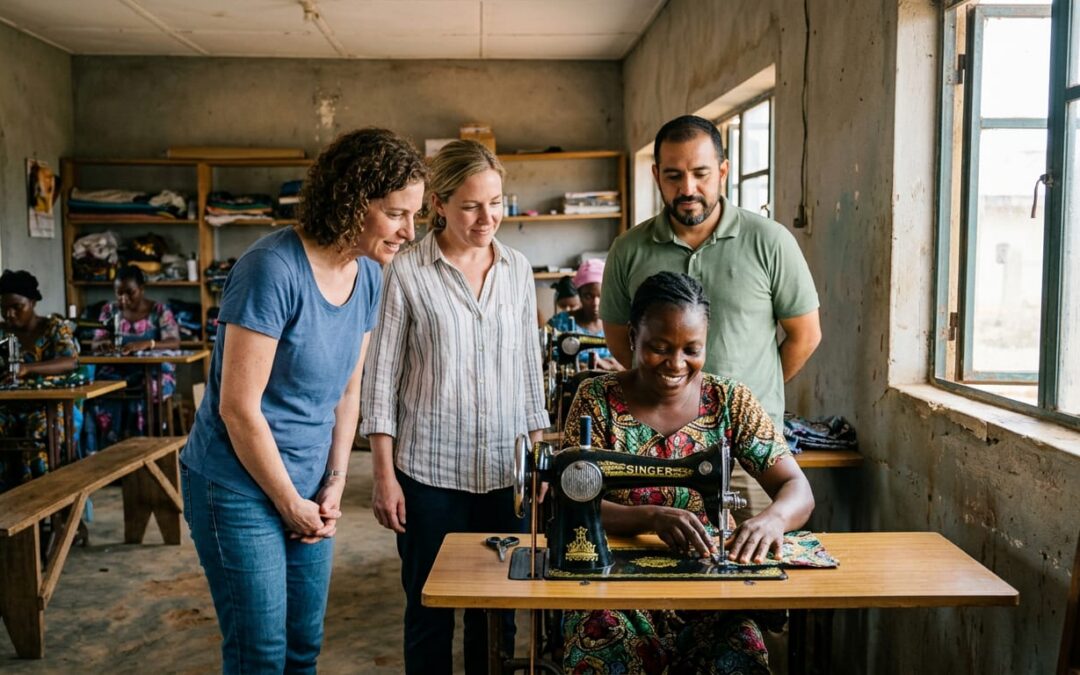
Impact Others Inc. funds clean water, food, orphanages, education, and new business opportunities through trusted local partners, so donors find real purpose in their giving. Those local partners manage projects on the ground and provide project documentation that Impact Others Inc. uses to communicate progress to its donors. Beyond that, Impact Others Inc. takes donors on trips to project locations – not as a luxury, but as a transparency mechanism. A humanitarian nonprofit donor trip puts you in the same room as the people your generosity reached. That kind of accountability is not available at most organizations, local or international.
The question is not whether you can see the work – it is whether the organization makes it possible for you to see it.
Where Does a Dollar Go Further – Locally or Internationally?
In 2025, a one-week medical outreach clinic funded through Impact Others Inc.'s local partners in Ghana provided medical and vision care to more than 2,100 people, with donated eyeglasses restoring vision for many patients. That is the scale of what a concentrated, well-managed international project can accomplish.
Cost of living and infrastructure realities mean that the same dollar often addresses more acute need internationally than domestically. A small business grant that might cover one month of startup supplies in the United States can fund an entire new livelihood in a country where economic barriers are steep. In Nigeria in 2025, seven widows received financial assistance to launch small businesses, creating pathways toward long-term independence – a level of transformation that required far less capital than a comparable domestic program would.
That does not make local giving less meaningful. Local communities have real needs – hunger, housing, safety – and proximity creates its own kind of accountability. If your passion is your own city or region, that calling is worth following. But if you want to find a humanitarian cause to support that stretches your dollar toward the most acute need, international giving through a trusted organization is worth serious consideration.
Can You Stay Connected to International Giving the Way You Can With Local Work?
One of the most honest objections to international giving is emotional distance. When you volunteer at a local shelter, you see faces. You know names. The connection is immediate.
International giving can feel abstract by comparison – and when giving feels abstract, it tends to stop feeling purposeful.
The organizations that solve this problem do it through documentation, community, and access. Impact Others Inc. shares project progress with donors, organizes site visits to project locations, and builds a community of supporters who understand what their generosity is producing. Mindy Tibbs, an Impact Others partner for about four years, described the shift this way: "When I think about Impact Others, I picture my own children in a third-world country. If a business owner had the answer to what my child needed – whether it was clean water from a well, a sewing center, food, an orphanage, housing, or any of the other life-changing resources – would they give? That's why I partner with Impact Others. It's making a real difference."
That is not an abstract relationship with a cause. That is personal investment – the same emotional connection local giving provides, built through a different kind of proximity.
If you want to see what that connection looks like in practice, thinking about what kind of people become regular donors to a humanitarian nonprofit can help you recognize whether this kind of giving fits who you are.
What Should You Look for in an International Giving Organization Right Now?
In 2026, donor scrutiny of international nonprofits is higher than it has ever been – and rightly so. Before you commit to any international giving, the questions worth asking are structural, not just emotional.
Does 100% of your project donation reach the project? Most nonprofits take a percentage off the top for overhead before a dollar reaches the field. Impact Others Inc. sends 100 percent of project-related donations directly to projects, keeping administrative expenses low compared to most nonprofits.
Does the organization work through vetted local partners? Organizations that parachute in from the outside rarely produce sustainable outcomes. Local partners who live in the community, understand the culture, and manage the work day-to-day are the difference between a project that lasts and one that doesn't. Understanding how an organization selects and oversees those partners matters – the local partner vetting process is one of the most important questions a donor can ask.
Can you visit? An organization that offers donor trips to project locations is putting its credibility on the line in the most direct way possible. That offer is a meaningful accountability signal.
Is the need specific and verifiable? Vague appeals to "help people in need" are different from specific, documented projects – a clinic in Ghana, a toy drive that reached 23,136 children across more than 13 countries and the United States, widows in Nigeria launching businesses. Specificity is a proxy for organizational integrity.
So, Local or International – Which One Is Right for You?
The honest answer is that this is a values question as much as a logistics question. If a local cause has captured your passion and you want to give where you can see the work directly, that is a meaningful way to do good. Local needs are real.
But if you want your generosity to reach people facing the most acute deprivation – those without clean water, food security, or any economic foothold – and you want to stay connected to that work through a trustworthy organization, international giving through a well-structured nonprofit is not a leap of faith. It is a deliberate, informed choice.
The deciding factor is not geography. It is whether the organization you choose can show you, specifically and honestly, what your donation produced. When you're ready to take that step, the Donate page at Impact Others Inc. is where you can put your giving to work.
To reach Impact Others Inc. directly, call 2196780669, email info@impactothers.com, or write to 5885 Cumming Hwy Ste 108347, Sugar Hill, GA 30518.
Checklist
- Clarify your values first. Ask yourself whether your passion points to a local community need or a global one – both are valid, but knowing which drives you makes the decision clearer.
- Ask any international humanitarian nonprofit what percentage of your donation reaches the project directly – not just what their overhead ratio is, but whether project donations go 100% to the field.
- Look for organizations that work through trusted local partners, not ones that manage projects entirely from abroad without community roots.
- Ask whether the organization offers donor site visits to project locations – this is one of the strongest transparency signals available to a donor considering international giving.
- Match the cause type to your giving purpose. Whether it is clean water, food, orphanages, education, or new business opportunities, giving toward a specific program area deepens your sense of connection and impact.
- Research the organization's track record – specific, verifiable outcomes (number of children reached, clinics run, businesses launched) tell you more than mission statements do.
FAQ
Should I donate locally or internationally if I want my money to go further?
Internationally, a dollar often addresses more acute need because cost-of-living and infrastructure differences mean the same amount can fund a medical clinic visit, a business startup, or clean water access in ways that are harder to replicate domestically. The key condition is choosing an organization that sends 100 percent of project-related donations directly to the project and works through accountable local partners on the ground.
Which types of needs are typically funded through international humanitarian nonprofits?
International humanitarian nonprofits like Impact Others Inc. typically fund clean water projects, food programs, orphanages, education initiatives, small business opportunities, and community outreach like toy drives. These address foundational survival needs that remain severe in many countries and that local governments and markets have not yet met.
Who tends to give internationally rather than locally?
Donors who give internationally often feel called to reach people facing the most acute deprivation – those without access to clean water, food security, or economic opportunity – and want their generosity to cross borders when the need is greatest. They are not indifferent to local need; they are drawn to scale and to causes where a relatively small amount of funding can produce a measurable, life-changing outcome.
How do I know an international nonprofit is actually accountable with my donation?
Look for three things: a clear policy that project-related donations go 100% to the project; a documented process for vetting and overseeing local partners who manage the work; and an offer to take donors on site visits to project locations. Organizations that do all three are putting their credibility on the line in concrete, verifiable ways – not just making promises.
What is the difference between giving to a local charity vs. an international one in terms of donor connection?
Local giving offers geographic proximity – you can visit the food bank or shelter yourself. International giving requires organizations to build connection through documentation, community, and access like donor trips. The best international nonprofits close that gap so donors feel personally invested in the outcomes their generosity produces, not just financially transactional with a cause.
Where does Impact Others Inc. fund projects internationally?
Impact Others Inc. funds projects through trusted local partners in countries including Ghana, Nigeria, Honduras, India, Egypt, Colombia, and Thailand, as well as foster care and community work in the United States. Project areas include clean water, food, orphanages, education, new business opportunities, and toy drives.
Is it possible to give to both local and international causes without spreading my giving too thin?
Yes – many donors give to both, often by choosing one international organization they trust deeply and one local cause they can engage with directly. The more important question is whether each organization you support is accountable with your donation, specific about outcomes, and aligned with what you personally care about. Giving with focus and intention matters more than the geography of the cause.