Food insecurity doesn't look the same in every community, and a food assistance model that ignores that reality doesn't serve people well. Impact Others raises funds from donors and sends those funds directly to trusted local partners who design and deliver food programs suited to the specific conditions of the communities they serve. The people reached include children, families, and vulnerable individuals facing real food insecurity – and 100% of project-related donations go directly to that work.
That last point matters more than it might sound. When donors give toward food assistance through Impact Others Inc., none of those funds are absorbed by administrative overhead before they reach the project. The local partners who know their communities best are the ones deciding how food is sourced, prepared, and distributed.
Who Designs the Food Programs, and How Are They Delivered?
Impact Others Inc. is a funding and stewardship organization, not a field operations team. That distinction shapes everything about how food assistance actually reaches people. Rather than managing kitchens, supply chains, or distribution logistics from a headquarters in Georgia, Impact Others raises donor funds and sends them to established local partners who already have the trust, the relationships, and the on-the-ground knowledge to run effective feeding programs.
Those local partners manage their own expenses and operations. They know whether a community needs a daily feeding center, supplemental nutrition for children, or something else entirely. Impact Others receives project updates from those partners and shares that progress with donors – so supporters stay connected to the work without the organization pretending to manage what it doesn't directly control.
This model reflects a genuine conviction: the people closest to the need are best positioned to meet it. A feeding program designed by someone sitting thousands of miles away, without local knowledge, rarely serves a community as well as one built by people already embedded in it.
What Kind of Food Insecurity Does This Work Address?
The food insecurity that Impact Others' partners work within isn't a background statistic – it's a daily reality for children and families in the communities where partners operate. One donor who attended an Impact Others Gala described what she heard about conditions in one of those communities:
"I heard Eddie describe how children would place their plates upside down because there wasn't enough food, and how they were fighting over kernels of rice while even the dogs were fighting over them as well. It was truly heartbreaking, and that story has stayed with me."
That account, shared by a donor (name withheld per privacy), captures something that a program summary never quite conveys. The need isn't abstract. It involves real children, real hunger, and real daily decisions about who eats and how much.
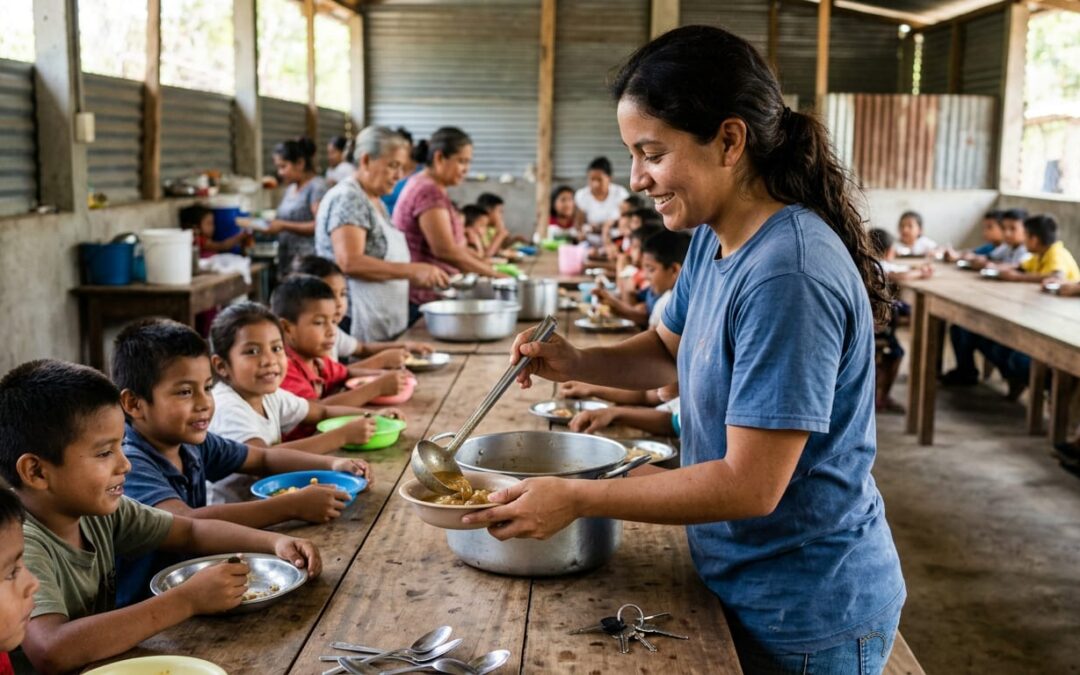
Food assistance through Impact Others' local partners may include structured feeding centers, regular meal programs for children in orphanages, and nutrition support for families in communities where food access is severely limited. The specific form the program takes depends entirely on what the local partner identifies as most needed and most sustainable in their context.
How Does Food Assistance Through Impact Others Compare to Donating Food Directly?
This is a question worth taking seriously, especially for donors who have considered local vs international giving and want to understand where their contribution creates the most durable change.
Donating food directly – sending physical goods, organizing food drives – can fill an immediate gap. But it doesn't build the infrastructure that feeds a community week after week. Local partners working through Impact Others funding can establish feeding centers, develop sourcing relationships with nearby suppliers, and run programs that continue beyond a single donation cycle.
| Approach | Strengths | Limitations |
|---|---|---|
| Direct food donation | Immediate, tangible | Logistically complex across borders, not sustained |
| Funding local food programs | Locally designed, sustainable, community-led | Requires trust in partner accountability |
| Impact Others model | 100% of project funds reach the project; local partner manages delivery | Donors don't control daily operations |
The key takeaway: funding a locally managed food program through Impact Others means the people who understand the community are making the day-to-day decisions – and the full value of a donor's contribution reaches that work.
What Does It Cost to Support Food Assistance, and What Does That Funding Cover?
Impact Others Inc. funds clean water, food, orphanages, education, and new business opportunities through trusted local partners, so donors find real purpose in their giving. On the food assistance side, what drives the cost of a program isn't a fixed number – it's the scope, the community size, the local cost of food sourcing, and the infrastructure the partner already has in place.
What donors can know with confidence is that 100% of project-related donations are sent to the project. That's not a rounding claim – it reflects how Impact Others structures its finances. Administrative expenses are kept deliberately low, and the organization does not take a percentage of project funds to cover overhead.
For donors thinking about which humanitarian need to direct giving toward, food assistance sits alongside clean water as one of the most immediate life-sustaining needs in the communities Impact Others' partners serve.
How Do Donors Know the Food Programs Are Actually Reaching People?
This is the accountability question, and it's a fair one. Impact Others receives project updates from local partners and communicates that progress to donors. But the most direct form of accountability available isn't a document – it's a site visit.
Impact Others takes donors on trips to partner locations so they can see the work firsthand. One donor who traveled to Honduras described the experience this way:
"I feel like it's very difficult to have a complete understanding until you physically put your hands on it. The impact that's been made here is just outstanding… I think I spent my first night crying. I woke up the next morning and cried after hearing John's stories, getting to meet kids at the first feeding center, experiencing things firsthand."
That testimony (name withheld per privacy) reflects something consistent across donor site visits: reading about a feeding program and standing inside one are two entirely different experiences. For donors who want to move beyond trust-at-a-distance, the humanitarian nonprofit donor trip option exists precisely for that reason.
Another donor couple put it plainly: "After meeting Eddie and seeing the integrity, the sustainability, and the boots-on-the-ground work – drilling wells, supporting feeding centers, and creating sewing centers – we decided to become partners." (Names withheld per privacy.)
What Happens Right Now – Is Food Assistance an Active Priority in 2026?
Food insecurity in the communities where Impact Others' partners work is not a historical problem waiting to be solved – it is an ongoing, present reality. Feeding programs run by local partners are active, not archived. As of 2026, Impact Others continues to fund food assistance as a core program area alongside clean water, orphanage support, education, and new business opportunities.
The need hasn't diminished. In many partner communities, food insecurity is compounded by limited economic opportunity, which is why Impact Others also funds small business development – because sustainable food security often depends on sustainable income, not just ongoing distributions.
What Is the Simplest Way to Understand How the Model Works?
Food assistance through Impact Others works because the organization doesn't try to be something it isn't. Impact Others raises funds, stewards them carefully, and sends 100% of project-related donations to local partners who are already embedded in the communities they serve. Those partners design the programs, manage the logistics, and reach the people who need it most – children, families, and individuals facing real food insecurity.
Donors who want to go deeper can choose which project their giving supports, travel to see the work in person, or give monthly and stay connected to progress over time. The Impact Others giving programs overview is a useful starting point for anyone exploring how to direct their support.
If you want to know more about how food assistance funding works or which active projects are accepting support right now, reach out directly. The team at Impact Others Inc. is at 2196780669, info@impactothers.com, or 5885 Cumming Hwy Ste 108347, Sugar Hill, GA 30518.
Checklist
- Ask specifically about active food programs – before giving, confirm which feeding projects are currently accepting donor support through Impact Others Inc.
- Understand the 100% model – verify that your donation designated for food assistance goes entirely to the project, with no portion redirected to administrative costs.
- Consider a site visit – donors who travel to partner locations with Impact Others gain a firsthand view of feeding centers and the communities they serve that no update can replicate.
- Match your giving to the need you care about most – food assistance is one of several humanitarian funding areas; knowing what drives your giving helps you stay connected to it long-term.
- Ask how local partners are selected – understanding Impact Others' vetting process for trusted local partners is a reasonable and important question for any serious donor.
- Start with a project-specific gift – if you're new to funding food assistance through a humanitarian nonprofit, a designated one-time gift toward a specific feeding program is a clear, accountable first step.
FAQ
How does food assistance through Impact Others actually reach people in need?
Impact Others raises donor funds and sends them directly to trusted local partners in the communities where food insecurity is most acute. Those local partners – not Impact Others staff – design and manage the feeding programs, source food, and oversee distribution. This means the people closest to the need are making the operational decisions, while Impact Others ensures the funds get there intact.
Who receives food assistance through Impact Others' partner programs?
The people reached depend on the specific project and the community the local partner serves. Programs may support children at feeding centers, families in communities with limited food access, or children living in orphanages where Impact Others also funds operations. The local partner identifies who is most vulnerable in their context and designs the program accordingly.
Which countries have active food assistance programs funded by Impact Others?
Impact Others works with trusted local partners across multiple countries, including Honduras, Ghana, Nigeria, India, Egypt, Colombia, and Thailand, as well as foster care work in the United States. Food assistance is one of several program areas active across that network, though the specific form it takes varies by partner and community.
Does my entire donation go toward food assistance, or does some cover overhead?
When a donation is designated for a food assistance project, 100% of those project-related funds are sent to the project. Impact Others keeps administrative expenses deliberately low and does not take a percentage of project donations to cover organizational overhead. This is one of the clearest structural differentiators in how Impact Others operates compared to many nonprofits.
How is food assistance funding different from just donating canned goods or physical food?
Donating physical food can fill an immediate gap but doesn't build the infrastructure for sustained feeding programs. Funding a local partner through Impact Others allows them to source food locally, establish feeding centers, and run programs that continue over time – which creates more durable food security than a one-time supply drop. Local sourcing also supports the partner community's own economy.
Who decides how food programs are structured in each community?
The trusted local partners Impact Others funds make those decisions. They understand local food availability, cultural context, and community need in ways that a distant organization cannot. Impact Others' role is to raise and steward the funds, not to design or supervise field operations. This division of responsibility is intentional – and it's why the programs tend to reflect real community conditions rather than a standardized template.
What can I do if I want to see the food assistance work in person, not just read about it?
Impact Others takes donors on trips to partner locations, including communities where feeding programs operate. Donors who have made these trips consistently describe the experience as transformative – moving from an abstract understanding of food insecurity to a direct, personal encounter with the people the programs serve. Contact Impact Others directly to ask about upcoming donor travel opportunities.