
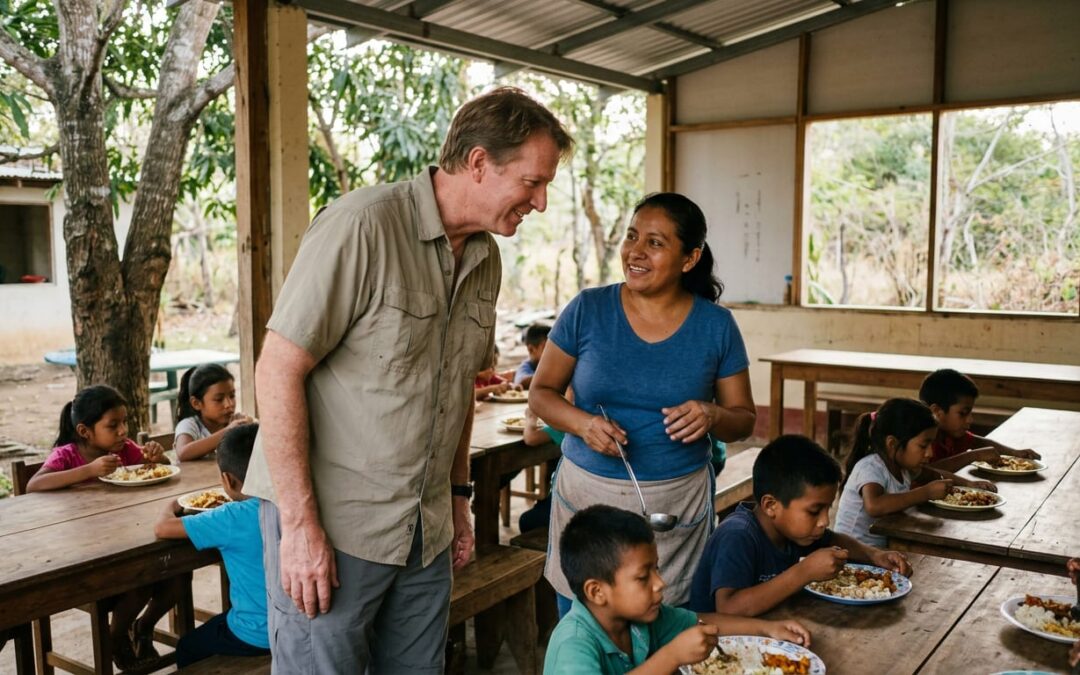
Yes, you can visit humanitarian projects funded by your donor-advised fund – but most organizations simply don't offer that option. Impact Others Inc. is built differently: donor trips to project locations are a core part of how the organization works, not an exception.
That distinction matters more than it might seem at first. When you direct a DAF grant toward a humanitarian project, you're working within a structure where, as the IRS notes, the sponsoring organization technically owns and controls the fund, and you hold only advisory privileges over distributions. You're trusting a system. A site visit turns that trust into something you can verify with your own eyes.
Why Do Most Humanitarian Organizations Restrict Donor Visits?
Most organizations limit or prohibit donor site visits for a few practical reasons – and understanding them helps you know what to look for in a partner that does things differently.
Operational complexity. Humanitarian projects are often located in remote areas – mountain villages, rural communities without paved roads, regions with limited infrastructure. Coordinating safe, meaningful access for outside visitors requires planning, local relationships, and logistical support that most nonprofits haven't built into their model.
Liability concerns. Organizations worry about what happens when a donor is injured, falls ill, or encounters security risks in an unfamiliar environment. Without a clear framework for managing those risks, many nonprofits simply avoid the exposure.
Cost structures. Hosting donor trips costs money. For organizations that pool administrative overhead into program budgets, adding a travel coordination function can feel like a distraction from the mission itself.
The arms-length funding model. Many large humanitarian nonprofits operate as grant-making intermediaries. They distribute funds to sub-grantees, who distribute to local implementers. By the time the money reaches the field, the original donor is four layers removed – and a site visit would require navigating every one of those layers.
None of these are unreasonable concerns. But they leave DAF donors who want firsthand verification with very few options.
How Does Impact Others Facilitate Donor Trips?
Impact Others Inc. takes donors directly to project locations – not as a marketing event, but as a genuine part of how the organization builds trust and accountability.
The organization works through trusted local partners who manage projects on the ground. Those partners know their communities, speak the language, and handle day-to-day operations. That local structure is precisely what makes donor visits possible: when Impact Others brings a donor to Honduras, Ghana, Nigeria, or another project location, there's already a relationship and a team in place to receive them.
One donor who traveled to the mountains of Honduras described crossing four rivers to reach a remote community. "The overall experience has just been incredible," he said. "The impact that's been made here is just outstanding… I think I spent my first night crying. I woke up the next morning and cried after hearing John's stories, getting to meet kids at the first feeding center, experiencing things firsthand."
That kind of encounter – water cisterns, feeding centers, the faces of the people being served – is what separates a verified grant from a trusted one.
Rob and Bernice, who became Impact Others partners after one of these trips, put it plainly: "After meeting Eddie and seeing the integrity, the sustainability, and the boots-on-the-ground work – drilling wells, supporting feeding centers, and creating sewing centers – we decided to become partners."
For DAF holders who want to verify donor-advised fund impact beyond what documents alone can show, a site visit does something no summary can replicate.
What Can DAF Donors Actually See on a Project Visit?
Visits vary by location and timing, but Impact Others' humanitarian work spans several program areas: clean water access, food and feeding centers, orphanage support, education, medical aid, and small business startups. Depending on where you travel, you might see a completed water cistern, sit with children at a feeding center, or meet a woman running a sewing business her community launched with grant support.
A young girl in Nigeria, speaking through an interpreter, described what a clean water project meant to her family: they used to walk long distances to fetch water from a stream shared with animals. "We thank you Impact Others for helping us get this clean water that we don't have to walk many miles to get."
That's not a statistic. It's a conversation. And it's the kind of accountability that feels different than any document.
Impact Others Inc. funds clean water, food, education, and orphanages through trusted local partners – and invites supporters to visit the work in person.
One real estate developer couple based in Denver joined a trip to Guadalajara and came back as long-term partners. "One of the things we love about Impact Others is that you get to participate firsthand," they said. "You can be as involved as you want, but the great thing is you actually get to see the incredible work being done around the world."
Does Visiting a Project Create Any DAF Compliance Issues?
This is a fair question, and worth addressing directly. National Philanthropic Trust notes that federal tax law prohibits DAF grants from conferring any benefit that is more than incidental to the donor or advisor. A donor trip that a nonprofit organizes as part of its accountability and stewardship model – where the visit is about witnessing the work, not receiving a personal benefit – is a different thing from a quid pro quo arrangement.
That said, this article is not legal or tax advice. If you have specific questions about whether a donor trip affects your DAF grant's compliance status, consult the sponsoring organization or a qualified advisor. The IRS updated its donor-advised fund guidance in September 2026, so it's worth reviewing current requirements with someone who knows your specific situation.
The practical distinction is straightforward: you are visiting to observe, not to receive. The nonprofit is not providing you with a vacation or a personal service. You're seeing where your grant went.
What Makes Impact Others Different for DAF Holders Who Want Hands-On Involvement?
Most DAF donors who ask about donor site visits run into a wall. The organization either doesn't allow visits, doesn't have a process for them, or operates at a scale where individual donors never get close to the work.
Impact Others is structured around the opposite premise. The organization keeps administrative costs low – and directs project-related donations entirely to the project itself, not to overhead. That structure is what makes it possible to stay close to the work and bring donors along.
For DAF holders and their financial advisors, that means a grant recipient whose impact isn't just described – it's observable. You can go. You can meet the people. You can ask questions and come home with photographs and stories that are yours, not borrowed from a brochure.
If you're interested in what this looks like in practice, the Giving section or donor trip information page on the Impact Others website is the right starting point.
Checklist
- Ask before you grant: Before directing a DAF grant to any humanitarian organization, ask directly whether donors can visit project locations – and what that process looks like.
- Understand the compliance line: A site visit to observe humanitarian projects is different from receiving a personal benefit. Confirm with your DAF sponsor how visits are treated under your specific fund's guidelines.
- Look for local partners, not just headquarters: Organizations that work through trusted local partners on the ground are far better positioned to host meaningful donor visits than those operating through multi-layer grant chains.
- Plan ahead: DAF donors interested in visiting Impact Others project locations should connect early – trips involve coordination with local teams in Honduras, Ghana, Nigeria, and other locations.
- Bring your advisor: Financial advisors helping clients incorporate philanthropy into their financial plans can attend donor trips too – firsthand observation strengthens the strategic giving conversation.
- Document what you see: Photos, notes, and personal stories from a site visit give you something concrete to share with family members, business partners, or other potential donors considering a humanitarian nonprofit.
FAQ
Can a DAF grant actually pay for a donor to visit a humanitarian project?
DAF grants cannot be used to pay for expenses that confer a personal benefit on the donor, advisor, or related parties – this is a federal tax law requirement, as National Philanthropic Trust notes in its grantmaking rules. The cost of a donor's travel to visit a project is typically a personal expense, not a grantable one. The visit itself, organized by the nonprofit as part of its accountability model, is a separate matter from how grant funds are used.
Who typically goes on Impact Others donor trips?
Donors, business owners, and their financial advisors have all traveled with Impact Others to project locations including Honduras and Guadalajara. Some come as individuals, others as couples or business partners. The trips are designed around seeing the work – feeding centers, water projects, orphanages, and small business programs – rather than as organized tours.
Which humanitarian project locations can DAF donors visit through Impact Others?
Impact Others works with trusted local partners in Ghana, Nigeria, Honduras, India, Egypt, Colombia, and Thailand, as well as foster care work in the United States. Not every location may be available for donor visits at a given time – the right starting point is contacting Impact Others directly to ask what's accessible and when trips are being planned.
How do I know a site visit will show me something real, not a staged presentation?
The structure of Impact Others' model is what provides that confidence. The organization works through local partners who manage projects day-to-day – those partners aren't assembled for a donor visit, they're the people doing the work year-round. Donors who have traveled with Impact Others describe unscripted encounters: crossing rivers to reach remote villages, sitting with children at feeding centers, hearing stories directly from community members.
Is visiting a humanitarian project worth it compared to just reviewing documentation?
Documentation tells you what happened. A site visit shows you how it happened and who it happened for. For DAF donors who want intentional giving that goes beyond paperwork, a visit to a project location produces a kind of confidence that no summary can replicate – and for many Impact Others partners, it's what moved them from one-time donors to long-term collaborators in the mission.
If you're a DAF holder or a financial advisor helping a client think through where their next grant should go, Impact Others Inc. welcomes the conversation. Reach out by phone at 2196780669, by email at info@impactothers.com, or by mail at 5885 Cumming Hwy Ste 108347, Sugar Hill, GA 30518. Ask about donor trips – it's one of the most direct ways to see whether this is the right partner for your giving.