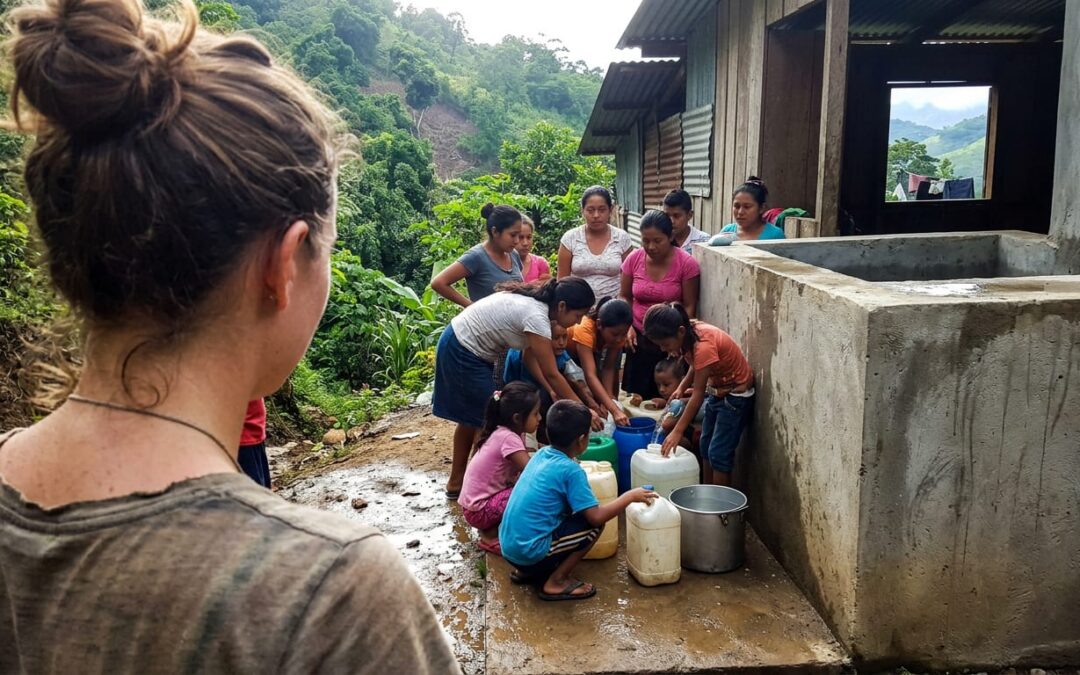
A community without reliable clean water doesn't just go thirsty – it reorganizes its entire existence around the search for it. Clean water access for communities that lack it means freedom from that daily burden: the freedom to go to school, grow food, stay healthy, and build something lasting. Without a nearby clean water source, community members often walk long distances each day, and children miss school to help collect water. With it, that time and energy goes back to the people who need it most.
What Does Daily Life Actually Look Like Without Clean Water?
Without clean water access, the absence shapes every hour of the day. Water collection often falls to women and children, who may walk several hours each way to reach a source that may not even be safe. By the time they return, the school day is over or the work day is gone.
The water they do carry back often comes from shared open sources – ponds, rivers, or shallow wells – that carry waterborne illness. Diarrhea, cholera, and typhoid are not distant abstractions in these communities; they are recurring threats that drain families of time, money, and sometimes their lives.
Food preparation, sanitation, and hygiene all depend on water. When water is scarce, people make hard choices: drink first, wash second, or don't wash at all. Small gardens and livestock – the foundation of household food security for many rural families – require water too. A community without clean water access is not just thirsty. It is caught in a cycle that touches education, nutrition, income, and health all at once.
How Does Clean Water Change What a Community Can Do?
Access to clean water transforms daily life in a community by reducing waterborne illness, freeing up time previously spent hauling water, and creating a foundation for health, education, and economic activity.
When a reliable clean water source exists close to home, children – especially girls – return to school. Adults reclaim hours that can go toward income-generating work. Families can maintain basic hygiene, which reduces illness and cuts the cost of medical care that many cannot afford. Gardens and small livestock operations become more viable, which improves nutrition and opens small income streams.
Clean water also supports sanitation infrastructure. Latrines and handwashing stations require water to function. When water is available, those systems work. When it isn't, they don't – and the health consequences spread through the whole community.
One donor who traveled to a clean water project in the mountains of Honduras described the experience this way: "The impact that's been made here is just outstanding… from the water cisterns project that we visited and got to see to the amount of people that have been fed and continue to be fed on a daily basis." That kind of firsthand observation – seeing a cistern full of clean water in a place that had none – is something no photograph fully captures.
Why Is Clean Water Considered a Foundation Rather Than Just One Need?
Clean water sits underneath almost every other development goal because so many things depend on it. You cannot run a feeding center without it. You cannot maintain an orphanage without it. You cannot teach children who are sick from waterborne illness or absent because they spent the morning hauling water.
This is why organizations that work across local vs international giving contexts consistently point to clean water as one of the highest-impact interventions available. It doesn't solve everything on its own, but it makes nearly everything else more possible.
For donors thinking about which humanitarian need to direct their giving toward, clean water projects carry a particular weight because of this compounding effect. A water cistern or well doesn't just serve one need – it opens the door to better nutrition, safer childhood, more consistent education, and the possibility of small economic activity.
That compounding effect is part of why Impact Others Inc. funds clean water, food, orphanages, education, and new business opportunities through trusted local partners, so donors find real purpose in their giving. Clean water is rarely the only project in a community – it's often the one that makes the others work.
What Should Donors Understand About How Clean Water Projects Are Funded and Delivered?
Funding a clean water project is not the same as building one. Impact Others raises funds and sends them directly to trusted local partners who manage clean water projects in communities that lack reliable access. Those partners understand the local geography, the community relationships, and the technical requirements. They manage the project and its expenses on the ground.
What Impact Others provides is the funding and the stewardship. The organization receives regular project updates from local partners and shares progress with donors – not through spreadsheets, but through documentation, photos, and for those who want to go further, the opportunity to see the work firsthand on a donor trip.
One donor who made that trip described the value of direct experience: "I feel like it's very difficult to have a complete understanding until you physically put your hands on it." Another, reflecting on what drew her to this kind of giving, put it plainly: "If a business owner had the answer to what my child needed – whether it was clean water from a well, a sewing center, food, an orphanage, housing, or any of the other life-changing resources – would they give?"
That question is the honest one. And for donors who want to know their donation is making a difference, clean water projects offer something concrete: a cistern, a well, a community that no longer organizes its day around finding water.
What Does This Mean for Someone Considering a Donation to a Clean Water Project?
Clean water access for communities that lack it is one of the clearest examples of giving that changes the structure of daily life – not just for one person, but for everyone who draws from that source. It is not a symbolic gesture. It is infrastructure that works for years.
For a donor who wants their generosity to reach a real place and do a specific thing, a clean water project is one of the most direct paths available. The need is documented. The solution is known. The question is whether the funding reaches the right partners who can execute it well.
If you want to give with that kind of confidence, you can reach Impact Others Inc. directly at info@impactothers.com, by phone at 2196780669, or by mail at 5885 Cumming Hwy Ste 108347, Sugar Hill, GA 30518. The team can walk you through current clean water projects, how funds are directed, and what it looks like to follow the work your giving makes possible – including the option to see it in person.
Checklist
- Before giving to a clean water project, ask whether the organization works through established local partners who manage execution on the ground – or whether it is attempting to manage construction remotely.
- If you want to see the impact directly, ask whether the organization offers donor site visits to funded clean water projects – Impact Others Inc. takes supporters to project locations so they can observe the work firsthand.
- When evaluating a humanitarian nonprofit's clean water work, look for project updates with photos or documentation, not just general impact language.
- Consider the compounding effect: a clean water project in a community also supports the feeding programs, orphanages, and small business opportunities that depend on water to function.
- If you're deciding between humanitarian needs, note that clean water access for communities is widely recognized as foundational – it enables health, education, and economic activity simultaneously.
- Ask what percentage of your donation reaches the project – organizations with low administrative overhead direct more of each dollar to the work itself.
FAQ
What is the first thing that changes when a community gets clean water access?
The most immediate change is time. When community members no longer need to walk long distances to collect water, that time returns to them – for school, for work, for rest. Children, particularly girls, are often the first to benefit because water collection had kept them out of school.
Who typically manages clean water projects in communities that lack access?
In most cases, trusted local partners – organizations with deep knowledge of the community, the terrain, and the technical requirements – manage the construction and maintenance of water infrastructure. Funding organizations like Impact Others Inc. raise and steward the funds, then rely on those local partners to execute the work on the ground.
Which communities are most affected by lack of clean water access right now?
Rural communities in parts of sub-Saharan Africa, Central America, South Asia, and other regions where infrastructure investment has been limited remain among the most affected. Impact Others Inc. currently funds work through local partners in countries including Honduras, Ghana, Nigeria, India, Egypt, Colombia, and Thailand, where clean water access remains a documented need.
How does a lack of clean water affect children specifically?
Children face compounded harm: they are more physically vulnerable to waterborne illness, they are often assigned the work of water collection, and they miss school as a result. Clean water access near a community removes all three of those barriers at once, which is why it is closely linked to improvements in school attendance and child health.
Does clean water access affect food security, or just drinking water?
Clean water supports not just drinking needs but also sanitation, food preparation, and the ability to sustain small gardens or livestock. In communities where household food production is part of daily survival, reliable water access can directly improve nutrition and reduce dependence on outside food sources.
How can I follow the progress of a clean water project I help fund?
Impact Others Inc. receives regular project updates from local partners and shares progress with donors through documentation and photos. Donors who want a deeper connection to the work can also join a site visit trip to see a funded project in person – a step several Impact Others supporters have described as transformative.
Where does the money actually go when I donate to a clean water project through Impact Others Inc.?
Impact Others raises funds and sends them directly to the local partners managing the project. The organization maintains independent bookkeeping and reports monthly financials to its board. Administrative expenses are kept deliberately low, so the funds raised are directed as fully as possible toward the work on the ground.