Organizing group charitable giving with family or coworkers is more straightforward than most people expect. The core steps are agreeing on a shared cause, deciding how contributions will be pooled, and choosing an organization that makes the giving visible and accountable. The harder part is sustaining it – keeping everyone engaged after the initial enthusiasm fades. That is where structure and a clear connection to real outcomes matter most.
Why Does Group Giving Feel Harder Than It Should Be?
Most people who give individually already have a rhythm – a cause they care about, an amount they're comfortable with, a level of trust they've built. Bringing others into that rhythm introduces new opinions, different priorities, and the practical question of whose name goes on the check.
The friction is real, but it's usually not about the cause. It's about process. When a group lacks a shared decision-making framework, the conversation stalls before the first dollar moves.
According to Fidelity Charitable, a family philanthropy process should begin with family members writing down their giving goals – including the timing, amount, and mode of giving they want the family to consider. That single step – getting individual intentions on paper before the group conversation starts – removes most of the friction, because it separates personal values from group logistics.
For employers and workplace giving groups, the same principle applies. Agree on what you're trying to accomplish before you agree on how much. A group that starts with "what do we care about?" lands on a decision faster than one that starts with "how much should each person give?"
What Are the Main Structures for Pooling Group Donations?
Once a group agrees on direction, the practical question is how to pool contributions. There are three common approaches, each with different levels of formality.
| Structure | Best for | Key consideration |
|---|---|---|
| Informal pooled fund | Families, small friend groups | Simple, low overhead, but no tax structure |
| Donor-advised fund (DAF) | Families or employers wanting tax efficiency | Requires a sponsoring 501(c)(3) organization |
| Employer matching program | Workplace giving | Employer sets the match terms and eligible orgs |
The Internal Revenue Service defines a donor-advised fund as a separately identified fund or account maintained and operated by a section 501(c)(3) sponsoring organization, where the donor or donor's representative retains advisory privileges over distributions and investments. For families who want to give together across multiple years – or who want to involve adult children in the giving decisions – a DAF creates a formal structure without the complexity of a private foundation.
One important note: to deduct a contribution to a donor-advised fund, the sponsoring organization must provide a contemporaneous written acknowledgment showing that it has exclusive legal control over the contributed assets. Consult a qualified tax advisor about your specific situation before making decisions based on deductibility.
For most families just starting out, an informal pooled approach – each person contributes a set amount to a shared fund, and the group decides together where it goes – is enough. The structure matters less than the shared commitment.
How Do You Keep a Group Engaged After the First Gift?
This is where most group giving efforts quietly fall apart. The first gift is energizing. The second requires intention.
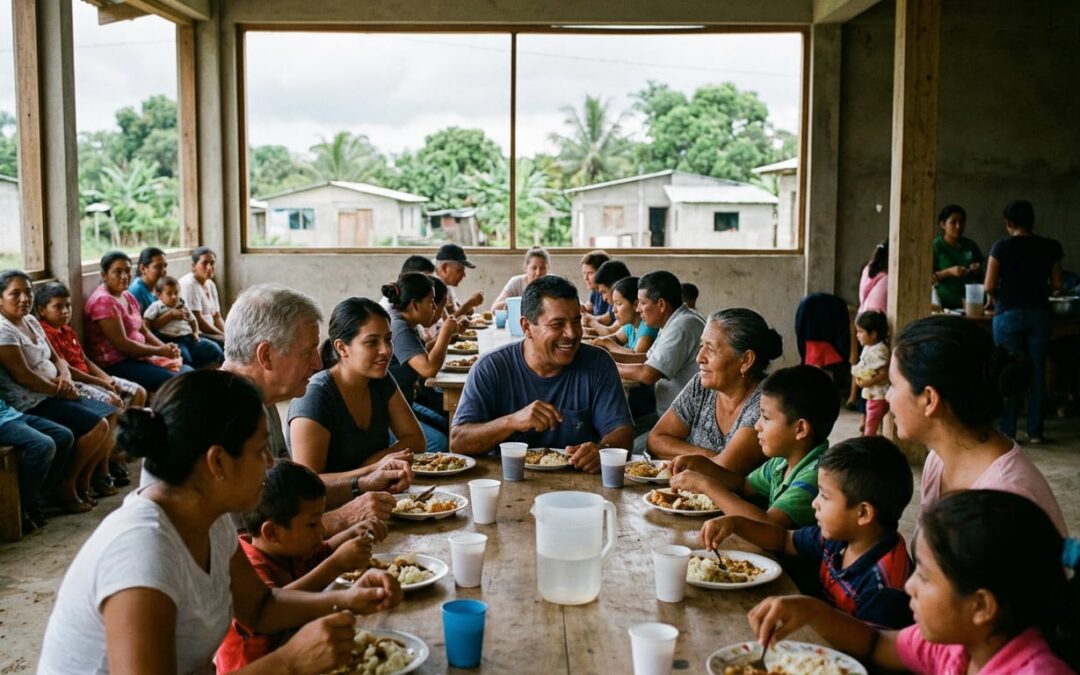
The groups that stay together over time share a few common habits. They give toward something specific – a water project, a feeding program, an orphanage – rather than a general fund. They receive updates that connect their contribution to a real outcome. And at least occasionally, someone in the group sees the work firsthand.
That last point is not a luxury. When a family member or a team leader travels to a project site and comes back with photos, stories, and a personal account of what the giving accomplished, the rest of the group re-engages in a way that no newsletter can replicate. It turns an abstract transaction into a shared experience.
When you give through Impact Others Inc., you can see exactly where your support goes – because we take donors to the places your giving changes.
Mindy Tibbs, an Impact Others Inc. partner for about four years, described it this way: "When I think about Impact Others, I picture my own children in a third-world country. If a business owner had the answer to what my child needed – whether it was clean water from a well, a sewing center, food, an orphanage, housing, or any of the other life-changing resources – would they give? That's why I partner with Impact Others. It's making a real difference."
That kind of personal connection is what turns a one-time group gift into a multi-year giving practice.
Which Causes Work Best for Group Giving?
The most durable group giving efforts center on causes that are concrete, visible, and broad enough that everyone in the group can find a point of connection.
Causes like food assistance humanitarian funding, clean water infrastructure, orphan care, and small business development for families in poverty all share a common quality: they produce outcomes that can be described in plain terms. A group that funds a feeding program can understand what their contribution accomplished. A group that funds a water project can see the well. A group that supports widow-led small businesses in Nigeria can follow the progress of seven specific women who received startup assistance to build long-term economic independence – which is exactly what happened through Impact Others Inc. partners in 2025.
That specificity matters for group cohesion. When the cause is abstract, group engagement drifts. When the cause is concrete – 23,136 children reached through a Christmas initiative across more than 13 countries, for example – the group has something to point to.
For employers considering a workplace giving campaign, concrete causes also make internal promotion easier. "We funded meals for 400 children this quarter" is a message that travels through a company. "We gave to a general humanitarian fund" does not.
The question of which humanitarian need should I direct my giving toward is worth working through as a group before committing – it often surfaces shared values that weren't visible when everyone was giving individually.
How Does Group Giving Connect to Something Larger Than the Gift Itself?
There is a reason that families who give together often describe it as one of the most meaningful things they do together – more than vacations, more than shared hobbies. Giving toward a cause that is larger than any one person's life creates a shared identity and a shared story.
For employers, a well-run giving program does something similar. It gives a team a reason to care about the same thing, which changes the texture of the workplace in ways that are hard to manufacture through other means.
The practical structure – the pooled fund, the cause selection, the updates – is just scaffolding. What the structure holds up is a group of people who have decided that their resources, combined, can change something real for someone they will probably never meet.
That decision, made together, tends to last.
If your family or team is ready to move from individual giving to a shared practice, Impact Others Inc. is a place to start that conversation. Our Group and Family Giving page walks through how other donors have structured their giving and what causes are available to fund right now.
Reach out directly at info@impactothers.com, call 2196780669, or write to us at 5885 Cumming Hwy Ste 108347, Sugar Hill, GA 30518. We would be glad to help your group find the cause and structure that fits.
Checklist
- Write down individual giving goals before the first group conversation – timing, amount, and cause preferences. This surfaces alignment and prevents the discussion from stalling on logistics.
- Choose a cause that produces visible, describable outcomes – a feeding program, a water project, an orphanage – so the group has something concrete to stay connected to.
- Decide on a pooling structure early – informal fund, donor-advised fund, or employer match – and confirm any tax questions with a qualified advisor before committing.
- Designate one person to keep the group informed about project progress, photos, and milestones. Accountability to a real outcome sustains engagement between giving cycles.
- Consider sending at least one group member on a donor site visit to a humanitarian nonprofit project, so the group has a firsthand account of where the giving goes.
- Revisit the cause and contribution level annually – group giving works best when it evolves with the group rather than staying fixed at the first decision made.
FAQ
Who should take the lead when organizing a family giving group?
There is no single right answer, but the person with the most existing giving experience – or the one who initiated the conversation – usually works best as the early organizer. Their role is not to decide for the group but to structure the first conversation: gathering individual giving goals, proposing a shortlist of causes, and suggesting a pooling method. Once the group establishes a rhythm, leadership can rotate or become shared.
Which pooling structure is best for a small family just starting out?
For most families giving together for the first time, an informal pooled approach – each member contributes an agreed amount, and the group decides together where it goes – is the simplest starting point. A donor-advised fund makes sense when the family wants multi-year flexibility or tax efficiency, but it requires working with a sponsoring 501(c)(3) organization and involves more setup. Start simple and add structure as the practice matures.
How do we make sure our group donation actually reaches the people it's meant for?
Choose an organization that sends 100 percent of project-related donations directly to the project – and that can show you the work, not just describe it. Impact Others Inc. takes donors to project locations so they can see the work firsthand, which is a more direct form of accountability than any document can provide. Concrete causes – a specific feeding program, a water project, an orphanage – also make it easier to follow what your contribution accomplished.
How much should each person in a giving group contribute?
Contribution amounts vary widely depending on the group's size, financial situations, and giving goals. What matters more than the amount is that each person's contribution feels voluntary and proportionate to their own capacity. Groups that set a single fixed amount often lose members who feel overextended or undercommitted. A percentage-based approach – each person gives a set percentage of their income or a personal giving budget – tends to sustain participation longer than a flat dollar requirement.
Where can a family or employer group see the humanitarian work their donations fund?
Impact Others Inc. funds projects in multiple countries, including Ghana, Nigeria, Honduras, India, Egypt, Colombia, and Thailand, as well as foster care work in the United States. Donors and donor groups can travel with Impact Others Inc. to visit funded project sites – clean water infrastructure, feeding programs, orphanages, and small business initiatives – and see the work directly. Contact Impact Others Inc. at info@impactothers.com to ask about upcoming donor trip opportunities.