
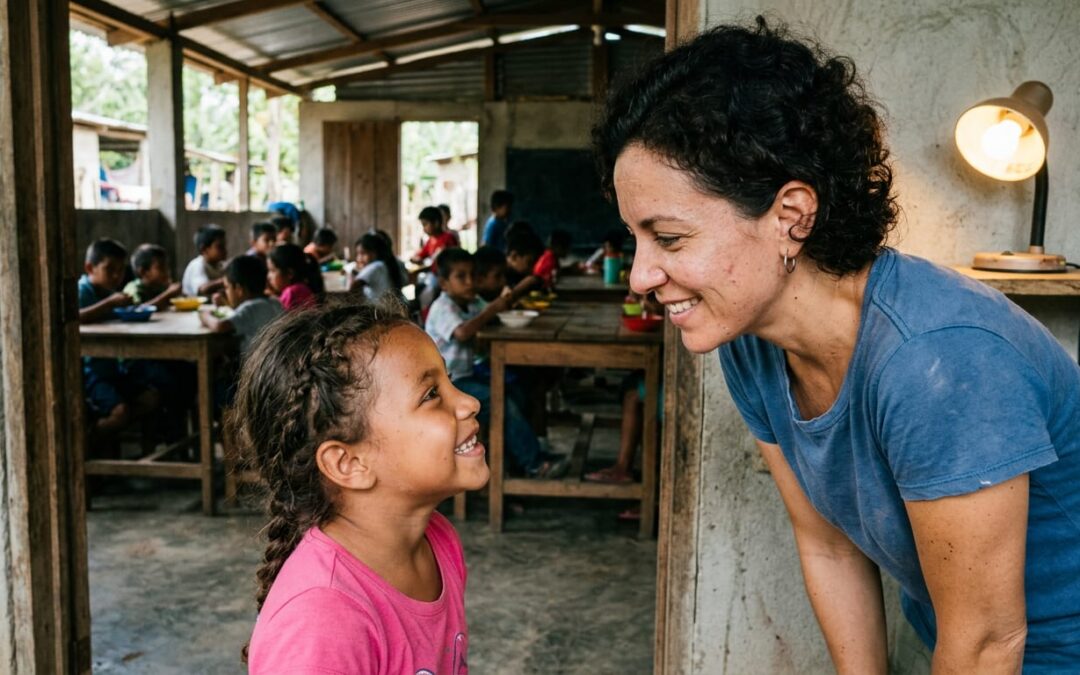
Experiential giving programs that include donor site visits are among the most meaningful ways to connect your generosity to real people and real places. For most donors, they are the best option available, though those who prefer a fully hands-off relationship with their giving may find a standard donation model simpler. Rather than writing a check and wondering what happened next, you travel to the project location – a feeding center, a water cistern, an orphanage – and witness the work with your own eyes. Impact Others Inc. structures its donor trips exactly this way, taking supporters directly to humanitarian project sites in countries like Honduras, Guatemala, Colombia, and beyond, where trusted local partners are doing the work on the ground.
What Actually Happens on a Donor Site Visit Trip?
A donor site visit is not a tourism experience with a charitable detour. It is a structured journey into the communities where your giving lands – and it changes how you understand what giving means.
On an Impact Others Inc. trip, donors travel to active project sites: feeding centers serving children daily, water cistern installations in remote mountain communities, orphanages providing safety and care, and small business development programs helping families build sustainable livelihoods. The itinerary is built around the work, not around comfort.
One donor who traveled into the mountains of Honduras described crossing four rivers to reach a remote community – trekking up and down steep terrain to meet the people the projects serve. "The overall experience has just been incredible," he said. "The work that they've done here is incredible from the water cisterns project that we visited and got to see to the amount of people that have been fed and continue to be fed on a daily basis."
That kind of access is what separates experiential giving from passive philanthropy. You are not reading a summary. You are standing in the place your generosity helped make possible.
On one delivery trip into the hills of Honduras, children began running toward the truck before they could even see what was inside. What started as a logistics run became, in the words of those who were there, "a celebration of hope." That moment – unscripted, unplanned, entirely real – is the kind of thing no newsletter can replicate.
How Do Experiential Giving Programs Build Trust Between Donors and Organizations?
Trust in a nonprofit is built through access, not through assurances. When an organization invites you to come see the work in person, the accountability is built into the invitation itself.
Impact Others Inc. sends 100 percent of project-related donations directly to the projects. Administrative costs are kept deliberately low. And donors who want to go further than a financial commitment can join a trip to verify the work firsthand – not through documents, but through direct presence.
This is what distinguishes donor field visits from standard nonprofit transparency practices. You are not being handed a summary of outcomes. You are meeting the people, walking the sites, and forming your own judgment.
One donor who joined a trip to Guadalajara put it plainly: "One of the things we love about Impact Others is that you get to participate firsthand. You can be as involved as you want, but the great thing is you actually get to see the incredible work being done around the world."
That firsthand participation is the accountability mechanism. It is the answer to the question every serious donor eventually asks: How do I know my money actually got there?
How Do Experiential Giving Programs Compare to Standard Donation Models?
| Feature | Standard Donation Model | Experiential Giving Program |
|---|---|---|
| Connection to impact | Indirect – updates and summaries | Direct – in-person site visits |
| Donor involvement | Financial only | Financial + relational + physical presence |
| Accountability method | Organizational self-reporting | Donor witnesses the work personally |
| Effect on giving motivation | Can fade over time | Deepens and sustains commitment |
| Cost to donor | Donation only | Donation + travel costs for the trip |
The table above reflects a meaningful trade-off. Experiential giving programs ask more of you – time, travel, and the willingness to be changed by what you see. In return, they give you something a standard donation cannot: the certainty of presence.
For donors who have been giving generously but feel a growing distance from the work they fund, a site visit trip closes that gap in a way nothing else does. As one donor who has traveled with Impact Others Inc. described it: "When you come on these trips and you just connect with people who think the same mindset and that want to give back… Impact Others has done the hard job. They find the places with the right infrastructure with the right means and we just come and give a little part of us and make a bigger impact in every place."
For those comparing options, understanding how nonprofit donor site visits work in practice – the logistics, the access, the relationship with local partners – is a useful starting point before committing to a trip.
What Does an Experiential Giving Program Cost, and What Should You Ask?
The cost of an experiential giving trip varies based on destination, group size, trip duration, and what is included in the itinerary. Impact Others Inc. does not publish fixed pricing for donor trips because each journey is structured around the specific projects being visited and the group traveling.
What matters more than a single number is understanding what drives the cost and what the cost covers:
- Travel and logistics – flights, ground transportation, and accommodation in or near the project communities
- Local partner coordination – the time and resources of the trusted partners who organize access and guide the visits
- Group size – smaller groups often allow deeper access but carry higher per-person costs
- Trip duration – longer trips that visit multiple project types (water, food, orphanage, business development) involve more coordination
What the trip cost does not cover is your project donation – that goes directly to the project, separately, at 100 percent. The trip is the experience; the donation is the impact.
Before committing to any experiential giving program, ask the organization directly: Who are the local partners managing the projects? Will I have direct access to the communities, or only to a curated presentation? And is the trip structured around the work, or around the donor experience? Those questions reveal whether the program is genuinely built for transparency or primarily for optics.
What Makes Experiential Giving a Purpose-Driven Choice in 2026?
In 2026, donors have more giving options than ever – and more reasons to feel uncertain about whether their generosity is reaching the people who need it most. Experiential giving programs answer that uncertainty by replacing assumption with presence.
The donors who travel with Impact Others Inc. are not looking for adventure travel with a humanitarian backdrop. They are people who have been giving, who care deeply, and who want their generosity to mean something beyond a transaction. They want to look into the eyes of a child at a feeding center, stand beside a water cistern that serves a mountain community, or meet a woman who launched a small business because someone believed her work was worth funding.
That is what purpose-driven giving looks like when it moves from intention to action. Impact Others Inc. connects donors with trusted local partners worldwide so every act of generosity reaches the people who need it most – and the donor trips make that connection something you can see, feel, and carry home with you.
If you are at the stage where giving generously is no longer enough and you want to witness the impact, the Donor Site Visits or Travel Programs page is where to start exploring what a trip with Impact Others Inc. looks like.
To learn more or ask about upcoming donor trips, reach out directly: call 2196780669, email info@impactothers.com, or write to Impact Others Inc. at 5885 Cumming Hwy Ste 108347, Sugar Hill GA 30518.
FAQ
Who should consider joining an experiential giving program?
Experiential giving programs are best suited for donors who give regularly and want a deeper connection to the work they fund – people who have moved past the question of whether to give and are now asking how to make their giving more meaningful. They are also a strong fit for business owners and couples who want to bring a giving component into their personal or professional identity in a tangible, relational way.
Which types of humanitarian projects can donors visit through Impact Others Inc.?
Donors can visit active project sites across multiple program areas: clean water installations, feeding centers serving children and families, orphanages providing safety and care, and small business development programs that help community members build sustainable livelihoods. Trip itineraries are built around the specific projects in the destination country, which have included Honduras, Colombia, and Guadalajara, among others.
Where do Impact Others Inc. donor trips actually go?
Impact Others Inc. takes donors to project locations in countries where trusted local partners are managing active humanitarian work, including Honduras, Colombia, and Mexico. The specific destination depends on which projects are active and accessible at the time of the trip. Communities visited are often in remote areas – mountain regions, rural villages – where the need is greatest and the work is most visible.
How is an experiential giving trip different from voluntourism?
Voluntourism typically involves donors or travelers performing hands-on labor at a project site. Experiential giving trips through Impact Others Inc. are structured differently: donors travel as witnesses and relational partners, not as a construction or service crew. The work is done by trusted local partners who manage the projects and their own teams. Donors come to see, connect, and deepen their commitment – not to replace the skilled local workforce.
How do I know the projects I visit are legitimate before I travel?
Vetting the organization before committing to a trip is a reasonable and important step. Reviewing an organization's track record, understanding how funds reach local partners, and asking about the local partner relationships are all part of that process. The article on donor trip credibility covers the specific questions worth asking before booking any humanitarian site visit.